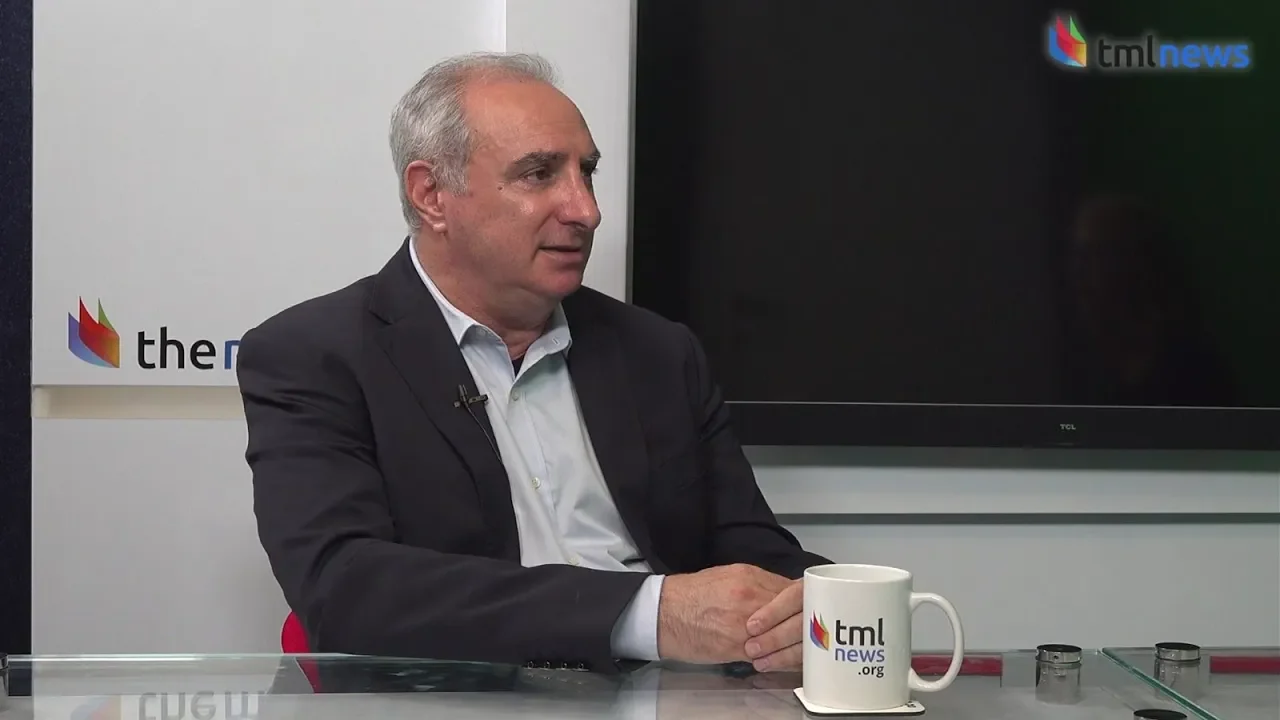
‘It Will Take Patience From All of Us’: Inside Ambassador Eitan Na’eh’s Mission To Strengthen Israel–Gulf Ties
In a candid interview with The Media Line, Israeli ambassador shares insights from his recent posting in Bahrain and past postings from Turkey to the UAE—marking both euphoric diplomatic advances and sobering realities of regional conflict
Few Israeli diplomats have had a career path as singular as Ambassador Eitan Na’eh’s, spanning postings from Turkey to the UAE and, most recently, Bahrain. Returning to Israel after nearly four years in Manama, Na’eh met with The Media Line to reflect on what it means to build diplomatic bridges in the Gulf amid regional tensions, war, and a global spotlight on the Abraham Accords.
Na’eh’s tenure as Israel’s first ambassador to Bahrain began in 2021, coinciding with the momentum of the Abraham Accords, which were intended to normalize relations between Israel and several Arab states. “Building relationships where there were none is a process which takes patience,” he remarked, noting the gradual nature of trust-building in international diplomacy.

Ambassador Na’eh presents his credentials to Hamad bin Isa Al Khalifa, December 2021. (Courtesy)
However, the outbreak of war between Israel and Hamas two years later cast a shadow over the diplomatic landscape and both ambassadors—the Bahraini envoy to Israel and Na’eh himself—were recalled. “I was called back for security reasons by our government,” he said. “It is, I think, almost natural that in time of war … things don’t move at the same pace as they were previously,” Na’eh explained.
Despite these setbacks, he emphasized that dialogue persisted, even during his absence from Bahrain. Messages were sent in both directions, from the highest levels to ambassador level and also through lower diplomatic ranks. The relation-building process was never severed. “Yes, it was delayed and it was stalled for a while, but never really cut.” Na’eh noted.
By late May 2024, the Bahraini ambassador had returned to Tel Aviv, while Na’eh resumed his duties in Manama in early June. The timing emphasized both the importance and resilience of ties in the region.
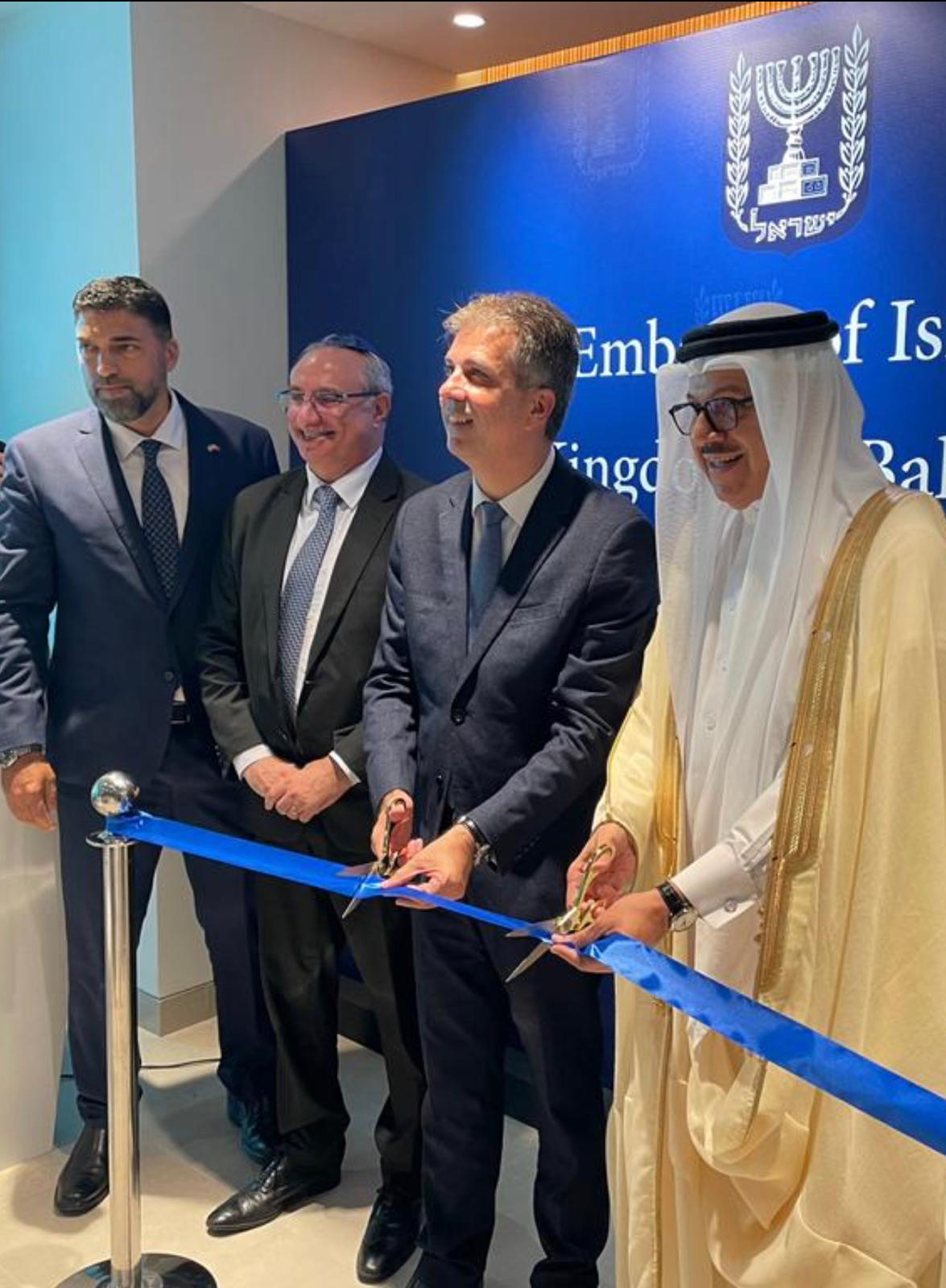
Ambassador Na’eh opens the new embassy in Manama, September 2023. (Courtesy)
The intention to continue building the relationship between the two countries was not kept secret. Public interactions between Na’eh and Bahrain’s prime minister and crown prince, including one to bid him farewell as he was leaving, were openly reported in the press. This sent a clear message that the relationship would continue on a trajectory towards closer ties.
During his tenure, Na’eh witnessed the slow but steady growth of bilateral engagement. High-level visits from Israeli officials—including the Prime Minister, President, and foreign ministers—were complemented by over 100 business delegations. These visits laid the groundwork for cooperation across trade, agriculture, and industry. In parallel, he leaned on grassroots public diplomacy: in Abu Dhabi at the start of Israel’s outreach, strangers in a café greeted him with “hello Jews” and sent cakes to the table—a small, telling moment of curiosity and welcome that he says he also felt in Bahrain. During violence in May 2021, he found himself in a sheikh’s salon where young locals, watching rolling coverage on Sky News Arabia, told him it was the first time they were hearing “the other side” directly from an Israeli official rather than through major networks. And beyond VIP trips, he points to first-time youth and media exchanges: “We sent a youth delegation for the first time in Israel,” he said, adding that recent Bahraini journalists’ visits helped challenge preconceptions.
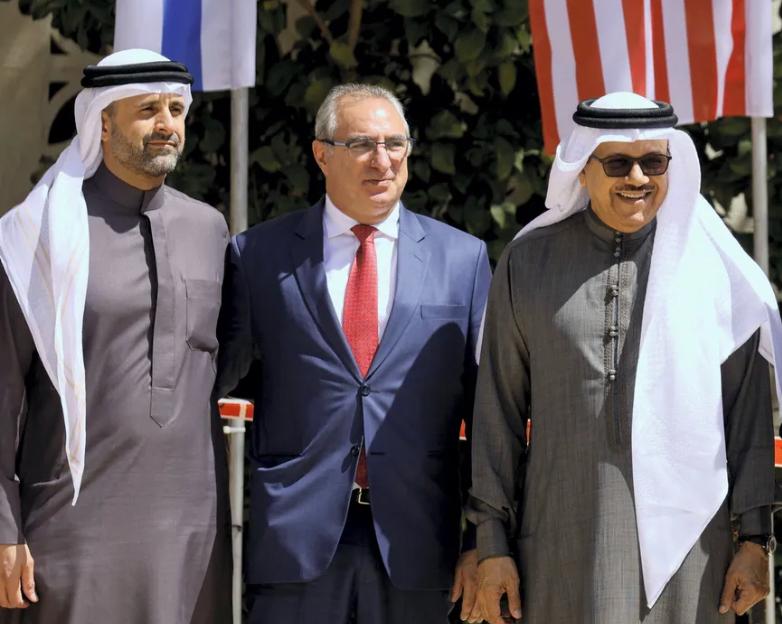
Ambassador Na’eh at a meeting of the Negev Forum in Sde Boker, Israel, March 2022. (Courtesy)
“For me, everything was startling,” he recalled. “Living in an Arab country, building relationships, seeing an embassy and embassy staff grow. … To really see cooperation grow in all fields was exciting.”
Give the gift of hope
We practice what we preach:
accurate, fearless journalism. But we can't do it alone.
- On the ground in Gaza, Syria, Israel, Egypt, Pakistan, and more
- Our program trained more than 100 journalists
- Calling out fake news and reporting real facts
- On the ground in Gaza, Syria, Israel, Egypt, Pakistan, and more
- Our program trained more than 100 journalists
- Calling out fake news and reporting real facts
Join us.
Support The Media Line. Save democracy.


Bahrain, as the smallest Arab state in the Gulf, offers logistical advantages, such as its proximity to the Mediterranean. Yet business requires careful cultivation, and it must make sense. “If it doesn’t, it won’t happen,” Na’eh said. “We have created opportunities, but it’s up to the businesspeople to take them.” He added that tourist flows reflected practical realities, with Israelis gravitating to the UAE’s larger, more developed tourism infrastructure, while Bahrain worked to define and “sell” its own destination profile.
Moving on to the topic of broader regional diplomacy, the ambassador resisted describing Bahrain and the UAE as test cases for Saudi-Israeli normalization. However, observing that each country has its own characteristics, he remained positive about the possibility of rapprochement with Saudi Arabia. “Give us time and a bit of optimism; things will happen,” he said.
Na’eh’s own journey into the Gulf was informed by both curiosity and preparation. Fluent in written Arabic and able to hold a conversation, he views language as a bridge to understanding culture, history, and regional dynamics. He advocates teaching Arabic in Israeli schools and says he chose the language “to get to know our neighbors” and even “to read the Quran in Arabic.” “If you want to expand relationships with the Arab world and Islamic world, yes, of course, we need to study about them as we want them to learn about us. That will remove some barriers, at least.”
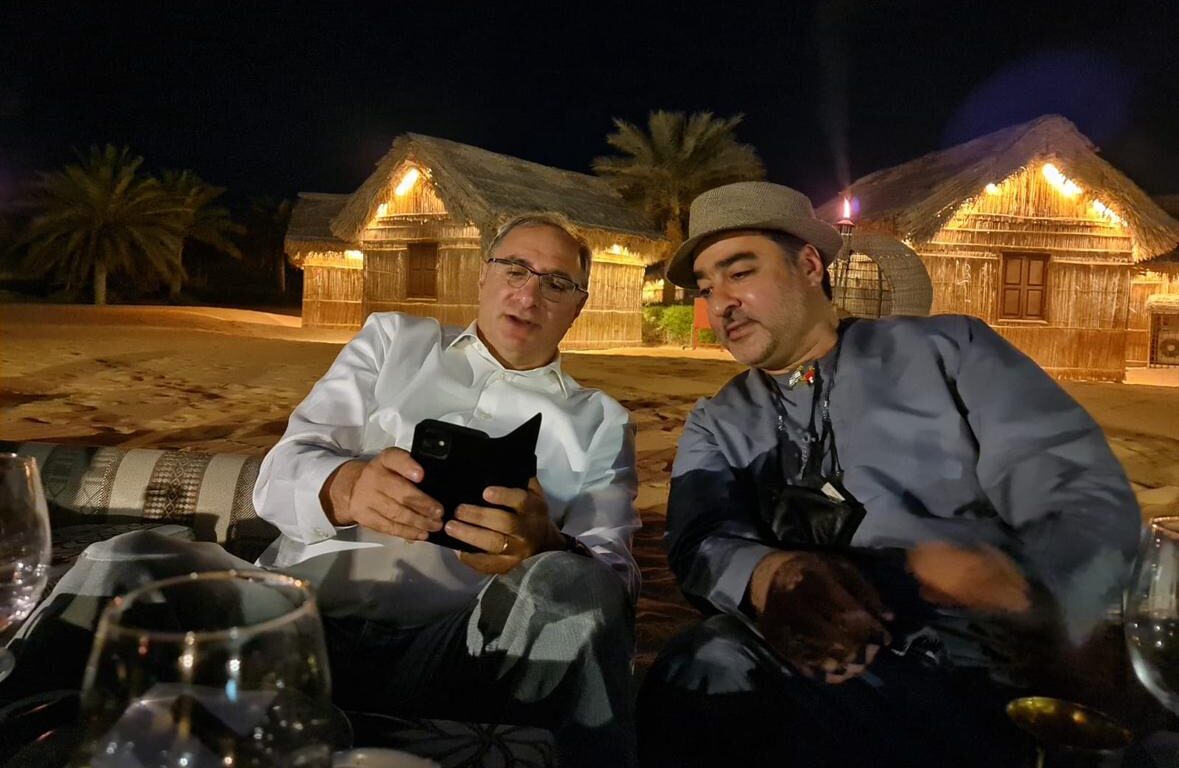
Ambassador Na’eh hosts local friends at a Passover Seder in the Abu Dhabi desert. (Courtesy)
This cultural fluency underpinned his approach to public diplomacy. Inviting Bahraini journalists, businesspeople, and youth delegations to Israel allowed for firsthand encounters with the country’s diverse society. “People came with kind of in the back of their minds that they had all these stereotypes, and then what they saw, what they thought is happening here … they saw something different,” Na’eh said. He recounted visitors observing Jews and Arabs strolling together in Tel Aviv, or hearing the call to prayer from Al-Aqsa, which challenged preconceived narratives.
Education and exposure, he argued, are the keys to changing perceptions among younger generations. Delegations, visits, and cultural exchanges allow participants to witness the complexities of Israeli society firsthand, bypassing media filters. “They don’t have to agree with us, always. They don’t have to love and kiss us, but they have to understand that the situation here is complex,” he said.
Trust-building, Na’eh emphasized, is central to diplomacy in the region. Reflecting on his previous postings in Turkey, from where he was expelled in the 1990s and returned later as ambassador, he noted the long arc of repair and renewal. After an apology in 2013 paved the way for a thaw, he returned as ambassador in late 2016 “to rebuild trust” at a time when ties had been downgraded to chargé d’affaires. Trade subsequently rose to the billions of dollars until the current war—evidence, he argues, that patient, practical cooperation can take root even after political shocks. “Trust is the first thing you build when you build relationships with countries that up until we opened an embassy … we didn’t have relations at all or normal relationships.”
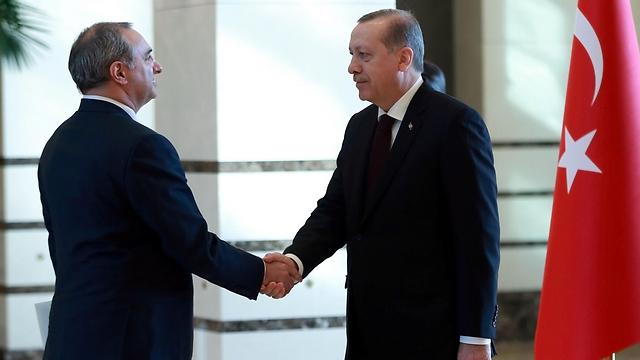
Ambassador Na’eh presents his credentials to Turkish President Recep Tayyip Erdoğan, December 2016. (Courtesy)
The Abraham Accords themselves, signed just five years ago, remain a work in progress. While the war with Hamas and the UN recognition of a Palestinian state have tested the resolve of these relationships, Na’eh argued that the foundational interests are strong. “We are at war for two years, and yet we have embassies in Abu Dhabi, a consulate general in Dubai, an embassy in Manama. These are new relationships, and they withstood the greatest test successfully.”
Beyond the Gulf, Na’eh expressed concern about antisemitism in Europe, particularly in the wake of recent attacks in Manchester. Drawing from personal experience—his brother-in-law narrowly avoided a terrorist attack at a local synagogue in the city—he criticized the perceived inaction of authorities. “There’s certainly much to do on the government level,” he said. “There’s more that can be done to make the Jews feel more safe.”
Despite the challenges of diplomacy, Na’eh remains optimistic. When asked to sum up his time in Bahrain in one word, he chose “patience.”
“It will take time. But it will happen. Because both sides have an interest to live in peace. … Peace is security. Peace is prosperity. And these two things take time. But we will get there.”
His reflections were not only professional but personal. Coming from a family with deep roots in the region, including ancestors in Hebron and Jaffa, Na’eh acknowledged the historical pain alongside the possibilities for reconciliation. “We cannot change the past, but we have to know the past,” he said. “The question is how we look to the future generations.”
Looking forward, Na’eh was cautious but hopeful. Relations with Turkey, disrupted by past political crises, have potential for renewal, though timelines remain uncertain. Within the Gulf, the promise of economic and cultural cooperation persists. And for Israel’s broader regional strategy, he stressed the slow, steady work of trust-building.
As he transitions from his post in Manama, the ambassador remains committed to the ideals that guided his work: engagement, dialogue, and patience. “Both sides have an interest to live in peace, certainly in the Gulf. They want to see what is peace. … How to get there? Let’s see,” he said with characteristic candor.
For now, Na’eh returns home to Israel, carrying the lessons of years spent cultivating fragile but promising relationships across the Gulf. His message resonates beyond diplomacy: building trust and understanding, particularly where history has left deep scars, requires perseverance and a willingness to see the human side of politics.
