Rampant Kalashnikovs and Street Executions Raise Fears of a New Gaza War
Reports of public killings, gun proliferation, and Hamas crackdowns fuel warnings that internal strife could derail reconstruction and fragile ceasefire arrangements
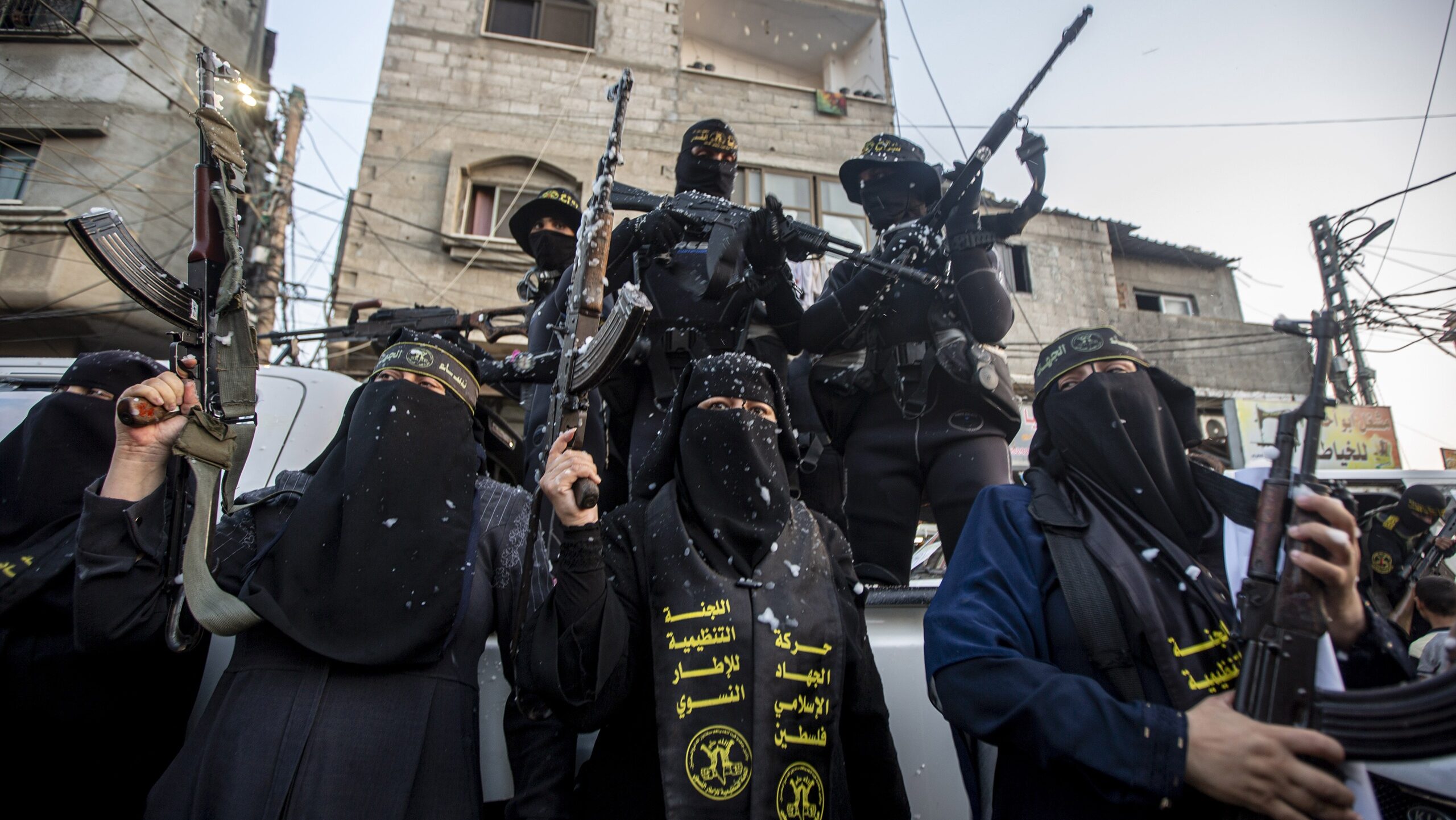
Gaza was expected to fade from the headlines after major combat ebbed—punctuated by President Donald Trump’s appearances in the Knesset and later at Sharm el-Sheikh—but intensifying internal tensions now threaten to overshadow the war itself. Hamas gunmen have fueled a new wave of violence that some locals called a “civil war rehearsal,” and residents describe deepening fear of a full-blown confrontation between Hamas and Palestinians who opposed the October 7, 2023 operation and its fallout across the Gaza Strip.
A widely shared video shows Hamas gunmen executing several Palestinians accused of looting homes or collaborating with Israeli troops—an elastic charge the group applies to anyone it deems disloyal. Gunmen, with Hamas ribbons tied around their heads, waved rifles and shouted as a crowd looked on, cheering what the gunmen were about to do. They seemed unfamiliar with live fire despite two years of relentless war. The most harrowing moment came when each armed Hamas fighter fired bursts into the backs of victims’ heads. None appeared willing to face the condemned. In seconds, several Palestinians were executed without due process.
It is extremely unfair for one to survive Israel’s two-year war only to be executed by Hamas
Critics argue the killings eclipse past abuses against fellow Palestinians, especially because they followed a war that displaced close to 1.7 million people as the death toll climbed to around 70,000. “It is extremely unfair for one to survive Israel’s two-year war only to be executed by Hamas,” said Mousa, a human rights activist in Gaza who was once rounded up, beaten, and questioned by Hamas security forces about his criticism of the movement’s behavior and its treatment of Palestinians who did not belong to Hamas. This is totally insane, he said.
During Israel’s airstrikes and bombardments, civilians bore the brunt while Hamas gunmen sheltered in tunnels. Once the fighting paused, they felt safe enough to emerge and target civilians who had never supported them, including those who backed the Palestinian Authority, the mainstream Fatah movement, and other Palestine Liberation Organization factions.
Context around governance is crucial here. Following Israel’s pullback to a de facto “yellow line”—a Trump-era concept for delineating Israeli positions and reducing friction inside Gaza—Hamas was reportedly given a time-limited remit over internal security to keep order, police crime, and prevent clashes during an interim phase. That mandate, according to Palestinian sources and community advocates, became a tool to suppress dissent and punish critics of Hamas’s wartime conduct. Viral footage of executions of suspected collaborators, including during the war, drew international condemnation.
President Trump confirmed that his administration gave Hamas a temporary green light to maintain security and calm in the Gaza Strip. The US president appears to have believed the group would honor that tacit permission. He was wrong. Even a meeting days earlier between Steve Witkoff and Jared Kushner and Hamas chief Khalil Al Hayyeh failed to secure compliance. However, Witkoff expressed his condolences to Al Hayyeh for the death of his son, killed in an Israeli airstrike on Doha, Qatar. He told him they both belong to the same club of fathers who lost their sons. Witkoff’s son passed away at the age of 22.
Official reactions within the Palestinian polity were swift. The Palestinian Presidency condemned the extrajudicial executions and demanded an immediate halt to the violence. Maj. Gen. Tawfiq Tirawi, former head of the Palestinian General Intelligence, warned of a potential repeat of Hamas’s 2007 takeover and urged restraint to prevent renewed internal strife.
Testimony from the ground points to competing narratives of responsibility. Khalil, a Palestinian social worker in Gaza, said many there firmly believe that Prime Minister Benjamin Netanyahu and the Israeli government bear responsibility for the security and armed chaos. “What is happening today gives Netanyahu reasons to sleep at night without worrying about the Gaza headache. Hamas is doing the job on his behalf, by creating intolerable conditions on the ground that would deter any effort to launch the Gaza rehabilitation and reconstruction projects,” he said.
Give the gift of hope
We practice what we preach:
accurate, fearless journalism. But we can't do it alone.
- On the ground in Gaza, Syria, Israel, Egypt, Pakistan, and more
- Our program trained more than 100 journalists
- Calling out fake news and reporting real facts
- On the ground in Gaza, Syria, Israel, Egypt, Pakistan, and more
- Our program trained more than 100 journalists
- Calling out fake news and reporting real facts
Join us.
Support The Media Line. Save democracy.
What is happening today gives Netanyahu reasons to sleep at night without worrying about the Gaza headache
Another Gazan named Khalil—a taxi driver who lost both his vehicle and home—recounted spending much of the war darting between damaged buildings in search of a sheltered corner to sleep. During the day, when possible, he went to the beach for a salty bath—a “luxury” many in Gaza did not have. He added that foreign media would find a “juicy story” as Hamas spreads havoc, while residents fear that footage like the execution video could undermine the agreements to end the war. For them, Israel’s war may have paused, but an internal conflict may have just begun.
Arms proliferation is now a central driver of risk. Asked where the weapons fueling heavy clashes—clan-against-clan or Hamas fighters against the public—have come from, the social worker Khalil said the trade has become a booming business. Hamas gunmen killed by Israeli forces left guns that locals collected; others looted Hamas stockpiles. Many kept one or two rifles and sold the rest for thousands of dollars.
Reports from activists and local contacts suggest thousands of Kalashnikov rifles and other weapons have entered civilian hands, heightening the danger of prolonged urban fighting. Activists accuse the Israeli government of indirectly benefiting from the chaos, which could stall reconstruction and complicate international aid. They argue the unrest might also tempt Netanyahu to skip the second phase of the ceasefire agreement and resume the war now that Israeli hostages are back home.
Counterarguments come from the West Bank. A Palestinian official in Ramallah said Netanyahu has little incentive to restart the war because Hamas, by misrule and repression, is “doing all the bad work,” sparing him pressure from Washington to fully end Israel’s campaign in the Gaza Strip.
Political stakes, in the meantime, keep climbing. On the diplomatic front, many fear that Hamas’s violence against Palestinians will destabilize the region and undercut recent efforts to consolidate a ceasefire architecture, reopen crossings on predictable schedules, and sequence donor-funded reconstruction.
Evidence of small-arms saturation appears widespread to local observers. Samir, another contact in Gaza, said he needs no further proof that civilians possess personal weapons like the Kalashnikov rifle; he sees them everywhere. He added that he heard from Hamas fighters that thousands of Kalashnikov AK-47s were stolen whenever a chance arose or during lulls in attacks. This weapon, he said, is a classic recipe for civil war—well-suited to urban fighting, if little else.
Civil society organizations—especially those focused on civil and human rights—have pleaded with Hamas to stop the executions and gun proliferation before matters spin out of control. Some issued cautious statements to avoid provoking hot-headed gunmen who might target them for punishment or worse. They also contacted affiliates abroad, seeking help from foreign governments that might press Hamas to change course.
Accountability remains a core demand from rights advocates. Another activist from Rafah, Yousef, who is currently in Gaza City, said immediate measures are needed to halt extrajudicial killings and ensure accountability through legal and transparent processes. He added that viral images of internal violence risk shifting global narratives and affecting foreign aid and diplomatic engagement.
It has taken the roles of a prosecutor, a judge, and an executioner
Historical precedent informs today’s fears. Abdullah, a human rights advocate from Gaza City, said he was not surprised by the collective executions video. Hamas, he said, has been in this business before. “It has taken the roles of a prosecutor, a judge, and an executioner. There isn’t any law on earth that allows one person to fill in these three jobs and take someone’s life without any due process, let alone the fact that death penalties are barely used in many countries.” He was referring not only to actions during the latest two-year war in the Gaza Strip but also to earlier episodes, chiefly the group’s military takeover from the Palestinian Authority in June 2007.
Back in 2007, Hamas gunmen killed around 700 members of various Palestinian security services—not only in clashes but also in cold blood. Some gunmen shot seriously wounded Fatah members in the head to prevent their transfer to nearby hospitals; in other cases, they threw Fatah activists and police officers from high-rise buildings in Gaza—an enforced “skydiving to death.”
The mechanics of the current arms market merit a brief explanation. In post-conflict environments like Gaza, rifles and ammunition circulate through battlefield pickups, depot break-ins, family and clan caches, and smuggling along porous routes. AK-pattern rifles dominate because they are durable, simple to maintain, and effective at the short ranges typical of dense urban neighborhoods.
Risks to reconstruction are immediate and practical. If policing remains fragmented and reprisals spread, donors could slow disbursements, contractors may refuse to mobilize, and humanitarian agencies will face access constraints and staff safety concerns—especially in areas where weapons are ubiquitous and dispute resolution relies on armed leverage.
Scenarios over the next few months range from guarded progress to sharp deterioration. Best case: A vetted internal-security mechanism curbs reprisals, channels arrests to recognized courts, and links compliance to aid benchmarks. Base case: Episodic executions and clan flare-ups undermine trust, delay reconstruction schedules, and erode ceasefire sequencing. Worst case: Factional street battles entrench armed fiefdoms, crossings tighten, aid convoys stall, and external actors recalibrate in ways that invite renewed cross-border escalation.
