‘This Winter Will Be the Most Dangerous’: Desert Smugglers Drive Syria’s Captagon Surge
Smugglers exploit fog, dust storms, and Syria’s security vacuum along the Jordanian frontier to move stockpiled Captagon that now functions as hard currency in a collapsed economy
On November 17, 2025, at 2 p.m., a young Syrian man on a motorcycle stopped on a bridge along the Harasta Highway to film the task force rumbling below: a military convoy of pickup trucks mounted with anti-personnel machine guns, their beds packed with personnel in standard Syrian Ministry of Defense uniforms. The Border Guard forces were heading east through the Al-Dumayr area toward the Syrian Desert—a sparsely populated expanse stretching to the Iraqi border—with orders to raid drug traffickers’ hideouts in Tulul Al-Safa, Wadi Jleighem, and the Hammad region.
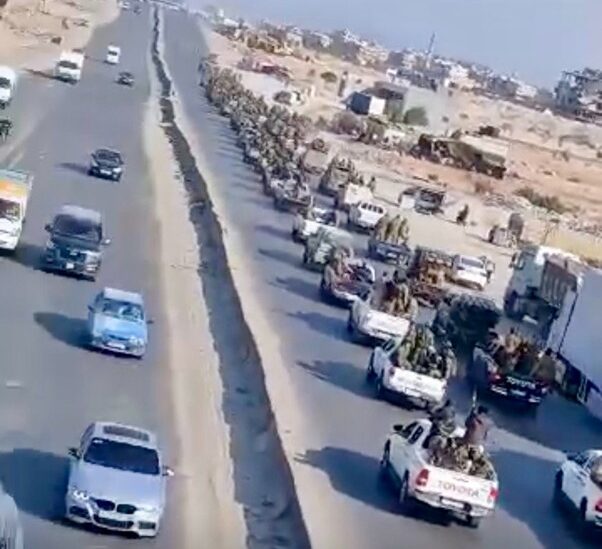
Syrian Border Guard forces deploy toward the Syrian Desert, Nov. 17, 2025. The convoy was en route to target Captagon smuggling operations near the Jordanian border. (Video still/eyewitness footage)
This deployment signaled Damascus’s latest attempt to stem a flood of narcotics that has made Syria synonymous with the global Captagon trade.
This winter will be the most dangerous
“This winter will be the most dangerous,” warned Abu Khaled, a gazelle hunter who has watched smuggling routes evolve across the desert terrain. “The stockpiles are huge, the need is desperate, and there’s no economic opening on the horizon.”
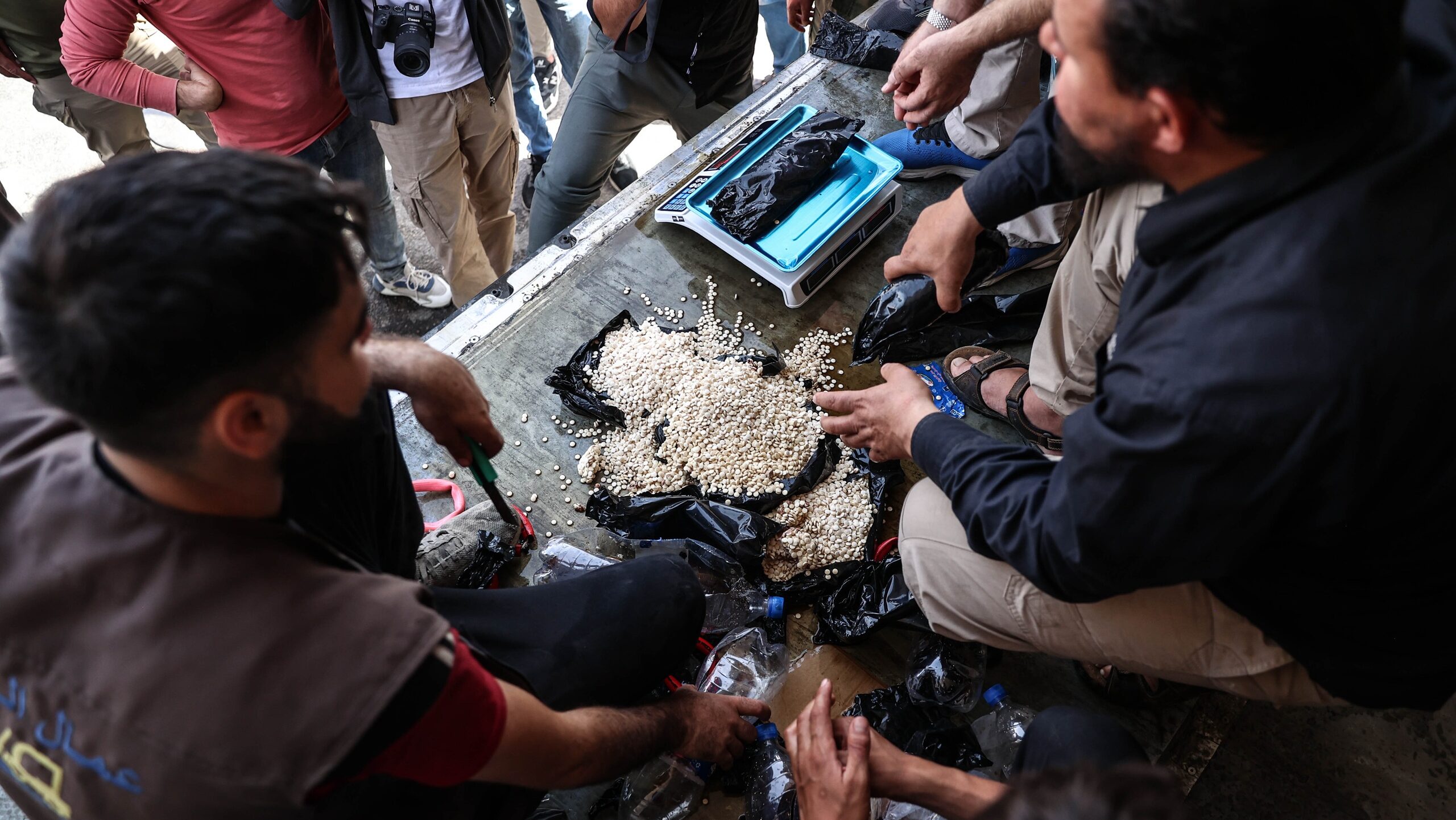
Nearly a year after rebel forces entered Damascus on December 8, 2024, and toppled Bashar Assad’s government, multi-ton stockpiles of Captagon—a synthetic, amphetamine-like stimulant that accounted for approximately 80% of global supply during the Assad era—are being liquidated through sophisticated winter operations that exploit both weather conditions and Syria’s security vacuum. While Damascus has dismantled state-sponsored production facilities, the trade continues through decentralized networks that operate with military precision but without government coordination.
Each winter, the 375-kilometer border between Syria and Jordan transforms into what smugglers call “the fog season.” Dense fog banks and dust storms roll across the frontier, defeating the thermal imaging cameras and motion sensors that form Jordan’s first line of defense.
Two main routes now dominate this trade. In the Al-Wa’er region—remote, rugged terrain along the frontier—smugglers navigate a network of wadis, including Ghadir Wadi Mahmoud, Wadi Abu Sharshuh, Tel Wutaid, and Tel Sada. Further east in the Hammad desert, organized teams use a vehicle-throw method: packages hurled from moving vehicles that Jordanian patrols struggle to track in real time.
“The technology has evolved significantly,” Mohammad Al-Abdullah, a community volunteer from rural Damascus who monitors drug trafficking, told The Media Line. “They’re using primitive drones that can carry 3 to 5 kilograms, and thermal balloons equipped with oxygen canisters to maintain altitude in cold air.”
Such innovation creates a paradox in interdiction statistics. Jordan’s Border Guard reported 593 smuggling attempts through September 2025—a figure suggesting intensified activity. Yet seizure quantities have declined, not because smuggling decreased but because traffickers adapted. Smaller, more frequent payloads slip through detection systems designed to catch bulk shipments.
According to Abu Khaled, speaking on condition his real name not be used due to security concerns, the routes reflect intimate desert knowledge. “These aren’t random paths. Every wadi, every ridge has been mapped for generations. Now that knowledge serves a different trade,” he said.
Driving the winter surge is a grimmer calculus: multi-ton quantities of Captagon warehoused in southern Syria near the Jordanian border—specifically As-Suwayda, Daraa, the Damascus countryside, and western Homs—represent liquid capital in an economy where traditional currency has collapsed.
“We have a saying now,” Al-Abdullah explained. “‘The camel costs one lira, but there is no lira.’ When drought forced herders to sell livestock, there were no buyers and no alternative income. Smuggling filled that void.”
Give the gift of hope
We practice what we preach:
accurate, fearless journalism. But we can't do it alone.
- On the ground in Gaza, Syria, Israel, Egypt, Pakistan, and more
- Our program trained more than 100 journalists
- Calling out fake news and reporting real facts
- On the ground in Gaza, Syria, Israel, Egypt, Pakistan, and more
- Our program trained more than 100 journalists
- Calling out fake news and reporting real facts
Join us.
Support The Media Line. Save democracy.


We have a saying now: The camel costs one lira, but there is no lira.
That economic desperation fueling the trade has been matched by a domestic health crisis. A report by MedGlobal, an international health organization, found drug consumption in Syria has increased 300% since the civil war began, with addiction rates among those aged 18–29 jumping from 3% to 9%. Syria maintains only four addiction treatment centers.
“We are nowhere near enough to treat the extent of the problem,” Dr. Ghamdi Faral of Ibn Rushd hospital in Damascus told researchers. As Captagon supplies tighten, users are shifting to crystal methamphetamine—a more dangerous substitute that reflects both scarcity and continued demand.
The human cost extends beyond addiction. On October 7, 2025, three members of the Al-Saeed family were killed by Jordanian forces during a smuggling operation. Their bodies were returned through the Nasib Border Crossing in November—a grim reminder that border security comes with lethal consequences.
Since Assad’s fall, smuggling networks have not disappeared—they have reorganized. During the civil war, Syria’s 4th Division—an elite unit commanded by Assad’s brother Maher—coordinated production and export. That vertical command structure collapsed in December 2024.
In their place are horizontal networks built on clan and tribal relationships.
Al-Abdullah described cooperation between Druze communities—members of a minority religious sect concentrated in southern Syria—and Bedouin tribes. “They developed working relationships over years. Those don’t disappear when a government changes,” he said.
This network operates with enough sophistication to maintain named coordinators. Syrian Druze smugglers, including Fares Saymoua, Taysir Saymoua, Radwan Al-Halabi, and Nasser Al-Saadi, have been identified by community monitors as key traffickers, with specific villages serving as staging points. Fares Saymoua and Nasser Al-Saadi are wanted by Jordanian security services.
Regional seizure data shows the trade’s scale beyond the Syrian-Jordanian border. Turkey’s Interior Minister Ali Yerlikaya announced in November 2024 that Turkish authorities seized 9.9 million Captagon pills through October. In March 2025, Iraq confiscated 1.2 tons of Captagon that had transited from Syria through Turkey, acting on intelligence from Saudi Arabia. That same month, a joint Syria-Turkey operation seized 9 million pills, demonstrating the new Damascus government’s willingness to cooperate internationally even as it struggles to control its own territory.
The first tangible sign of post-Assad cooperation came in October 2025, when Syrian and Jordanian forces conducted their first joint counter-narcotics operation. The mission seized approximately 1 million pills and foiled seven smuggling attempts—a modest success that revealed the gulf between rhetoric and capacity.
That partnership represents a milestone but remains asymmetric. Jordan deploys advanced detection systems, while Syria’s new Border Guard Administration, under the command of Brig. Gen. Hassan Abdul Ghani, was only formally established in 2025 and lacks basic surveillance infrastructure.
Challenges facing Damascus extend beyond equipment and personnel. International observers note that Syria’s new government inherited a security apparatus fragmented by 13 years of civil war and sectarian divisions.
UN Special Envoy Geir Pedersen emphasized in March that comprehensive security sector reform is needed, while Security Council members agreed that establishing a single, professional, unified force under rule of law remains essential. The Border Guard Administration represents one step in that direction, established less than a year after Assad’s fall with a mandate to professionalize border control long weaponized for regime profit.
On the ground, Salama Al-Zubaidi, a Bedouin herder, told The Media Line he is cautiously optimistic about Brig. Gen. Abdul Ghani’s appointment, but acknowledges reality. “It is a new and recently established administration, and it requires a great deal of logistical and human support to fill the security gap, control the borders, and train personnel professionally,” he said.
Beyond Syria’s borders, the stakes are regional. Jordan serves as a crucial transit route to Saudi Arabia and Gulf states—the primary markets for Captagon, where pills sell for $10-20 each. Smuggling threatens Jordan’s regional relationships and its reputation as a stable partner in counter-narcotics efforts. In January 2025, Damascus and Amman established a joint security committee to coordinate border control, but institutional cooperation requires infrastructure Syria does not yet possess.
Syria’s Interior Minister Anas Khattab declared in June 2025 that all Captagon production facilities had been dismantled. The claim reflects genuine efforts: factories in Latakia, Homs, and Damascus suburbs have been raided, equipment destroyed, and arrests made.
Yet the United Nations Office on Drugs and Crime (UNODC) sounded a note of caution in its World Drug Report 2025, released in June. The report confirmed Captagon continues to flow toward the Arabian Peninsula despite Damascus’s claims.
These criminal groups have been operating for a long time. The production will not stop in days or in weeks.
Angela Me, UNODC’s chief of research and trend analysis, explained the disconnect. “These criminal groups have been operating for a long time. The production will not stop in days or in weeks,” she said.
The report noted the ongoing trade likely reflects either stockpile releases or continued production in different, less detectable locations.
That gap between dismantling centralized infrastructure and stopping decentralized networks defines Syria’s current challenge. Al-Zubaidi observed that recent raids “disturb only the smugglers themselves—they relocate, regroup, and resume. Without sustained presence and local trust, enforcement is theatrical.”
“The fear now,” Al-Abdullah said, “is that more young men will be recruited into smuggling with tempting cash offers, even though they know they might be killed at the border.”
Ahmad Qwaider reported from Syria. Jacob Wirtschafter reported from Istanbul.
