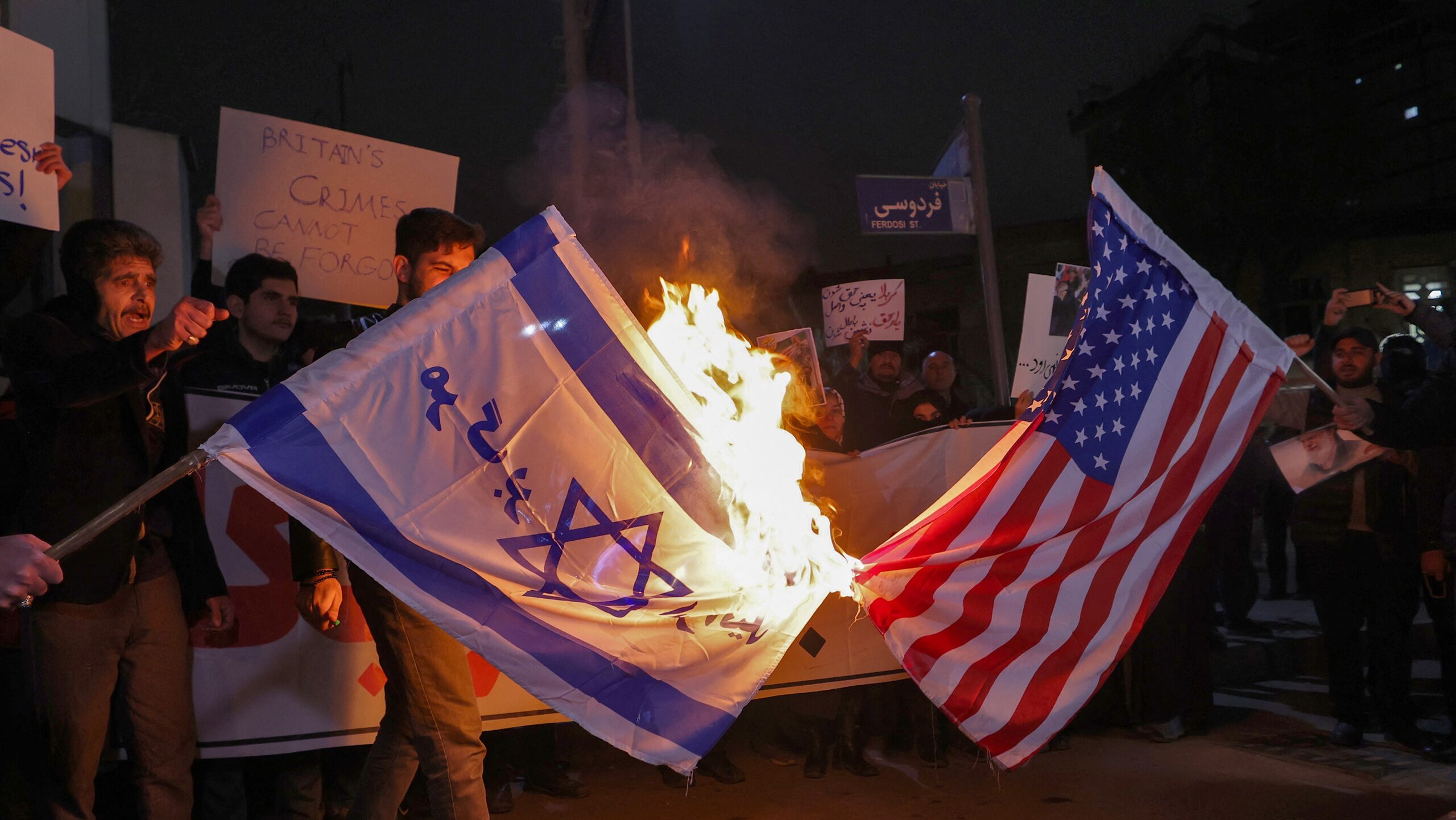
US Action on Iran Could Backfire by Unifying the Regime’s Base
Analysts warn that a strike could strengthen Tehran’s internal cohesion even as it weakens Iran’s regional network and raises the risk of wider conflict
As speculation mounts over a possible US military move against Iran, the situation inside the country continues to deteriorate. Human rights organizations and independent observers estimate that more than 10,000 people have been targeted in the latest wave of repression, with executions accelerating, mass arrests ongoing, and internet access severely restricted in an effort to disrupt coordination among protesters and limit information flows.
Against this backdrop, President Donald Trump has publicly suggested that help for the Iranian people “is coming,” describing the cost of inaction in moral terms. Yet what form that assistance might take—and when—remains unclear. Military intervention is only one of several scenarios analysts outline, and many caution that external pressure could reshape not only Iran’s internal dynamics but also the regional balance.
For Milan Vukelić, Ph.D., a researcher of religious fundamentalism and extremism, the question is not whether the United States can strike Iran, but whether doing so would produce the intended outcome—and at what cost.
It is unnecessary to discuss whether the US Armed Forces have the capacity for military intervention anywhere in the world, including Iran
“It is unnecessary to discuss whether the US Armed Forces have the capacity for military intervention anywhere in the world, including Iran. They represent the most formidable military power, which at present no actor can seriously challenge in military-intelligence terms,” Vukelić told The Media Line.
Still, he stressed that Iran is not comparable to other recent arenas of US military activity and that Tehran retains meaningful capacity to resist.
“Nevertheless, there are countries capable of offering lesser or greater resistance, and Iran is certainly one of them,” he said.
Vukelić assessed that Iran is weaker than in previous years due to setbacks among its regional partners.
“Iran is in a weaker position than in previous years, as its most significant allies have suffered serious losses during recent conflicts with Israel. Above all, this refers to Hezbollah, the Alawite regime of Bashar al-Assad—which is now a thing of the past—and the Ansar Allah movement, better known as the Houthis,” he said.
Even so, he argued Washington must weigh whether intervention would yield strategic gain—or inadvertently consolidate Iran’s domestic cohesion.
“The key issue for the United States is to carefully assess whether a potential military intervention in Iran would yield more benefits than costs, and to what extent losses might be incurred, since such an operation would entail a high level of risk and complexity,” Vukelić said.
He outlined potential triggers that could shift Washington from deterrence to action.
“What could prove decisive is intelligence indicating that Iran has enriched uranium to a level sufficient to produce a nuclear weapon,” he said, adding that “attacks on US economic interests” or “Iran’s closure of the Strait of Hormuz” could also trigger a military operation.
If a strike occurred, Vukelić expects it would be largely aerial, maritime, and cyber—rather than a ground war—yet he still anticipates retaliation against US regional basing.
At the same time, he emphasized that Tehran’s reduced network of capable allies does not eliminate danger, especially if the regime concludes it has little left to lose.
“If Iran were backed into a corner and brought into a situation in which it has nothing left to lose, the Iranian armed forces—led by the Revolutionary Guard—would attempt at all costs to preserve the regime, even at the price of greater bloodshed,” he said.
“Iran may be weakened, but even in such a state, it remains highly dangerous. It possesses numerical strength, solid armaments, and, crucially, a strong ideological orientation,” he added.
Crucially, Vukelić argued that external military pressure could unintentionally strengthen internal cohesion.
“A potential attack on Iran could confront the United States with the unification of Shiite populations, which throughout history have demonstrated the ability to overcome internal divisions when facing an external enemy,” he said.
Give the gift of hope
We practice what we preach:
accurate, fearless journalism. But we can't do it alone.
- On the ground in Gaza, Syria, Israel, Egypt, Pakistan, and more
- Our program trained more than 100 journalists
- Calling out fake news and reporting real facts
- On the ground in Gaza, Syria, Israel, Egypt, Pakistan, and more
- Our program trained more than 100 journalists
- Calling out fake news and reporting real facts
Join us.
Support The Media Line. Save democracy.

For that reason, he described nonmilitary destabilization methods as potentially more effective.
“For the United States, a far better option for destabilizing the theocratic regime would be to support secular currents within Iran, which are numerous, rather than risking, through military means, the unification of the Iranian nation itself,” Vukelić said.
From Israel’s perspective, the immediate strategic question is less about forecasting Iran’s internal trajectory than about preparing for the likely consequences of US action, especially retaliation.
Professor Kobi Michael, a senior researcher at the Institute for National Security Studies and the Misgav Institute, said Israel expects Washington to lead any operation, while preparing for escalation if Iran responds with strikes on Israeli territory.
“I think that the Israeli perception is that the United States will remain in the lead. But Israel prepares itself to be involved if the Iranians retaliate by attacking Israel. Israel will not contain it and will for sure pursue the beginning of the end of the regime,” Michael told The Media Line.
Michael described President Trump as caught between maintaining deterrence and avoiding a regional war he cannot fully control.
“If he wants to keep deterrence vis-à-vis all American adversaries, then he has to do something. Otherwise, if it will be only empty words, it will be a very problematic situation and can escalate to something way bigger,” he said.
Yet Michael also warned that a US strike could collide with Iran’s domestic dynamics in unpredictable ways, potentially emboldening protesters while also provoking harsher regime escalation.
At the same time, he said the Gulf states’ strategic preferences may diverge sharply: They may want regime change, but fear being pulled into the costs.
“By pressuring the United States through its allies here in the region—mainly Saudi Arabia, the Emirates, the Qataris—all of them are very frightened of Iranian retaliation and from escalation,” Michael said.
“Although they just hate Iran and they do want to see a change of the regime, they are not willing to be part of the escalation. They are not willing to pay the price,” he added.
Michael also addressed a point often blurred in outside debates: Even a significant strike from abroad does not automatically translate into regime change.
Only from the inside this can be fully achieved
“Only from the inside this can be fully achieved,” he said, when asked what would actually bring the regime down.
On Israel’s side, he stressed readiness for another round of direct Iranian missile fire while acknowledging limits to any defensive system.
“There is no 100 percent defense,” he said, adding that “it is enough that even a few missiles fall on a sensitive area, and we know what the consequences can be.” He added that the June 2025 strikes showed how quickly destruction and loss of life can follow.
Still, he argued Israel’s resilience and civil defense preparations shape the country’s ability to withstand temporary disruption.
“The Israeli resilience is maybe the strongest resilience compared to any other country in the world, so we are willing to take another bullet,” he said.
Where Michael’s assessment becomes most consequential is in his description of a possible regional alignment if Iran were to strike Israel after a US operation, particularly the prospect of discreet assistance from Arab states.
“Once the Iranians attack Israel by missiles, then Israel and the United States will retaliate stronger—and I think that will happen together, even with some Arab countries, although they will prefer to keep it beneath the table,” he said.
Asked which countries he meant, Michael replied: “First of all, the Saudis. But I think that the Emirates as well. And I think that Jordan and even Egypt.”
That possibility—Arab backing for containment and defense while avoiding overt participation—intersects with the cautious framing offered by Abdulaziz Bqish Alshaabani, a Saudi political analyst, who emphasized risk management and the absence of a detailed official Saudi public statement confirming policy on airspace.
“If media reports suggesting that Saudi Arabia does not favor allowing its territory or airspace to be used for military action against Iran are accurate, this position can be understood within the framework of regional risk management,” Alshaabani told The Media Line.
“There has been no detailed official public statement confirming such a policy, but if this approach is indeed in place, it would reflect Riyadh’s preference to avoid direct involvement in a confrontation that could carry wide security and economic repercussions,” he added.
Alshaabani also cautioned against treating “collapse” as imminent or definable, describing the indicators that regional actors would watch as hypothetical.
“From an analytical perspective, if Iran were to experience a significant level of internal weakness, regional actors would likely observe general indicators such as internal stability, cohesion of security institutions, and economic resilience. These are hypothetical analytical indicators rather than an assessment of any current specific situation,” he noted.
On the consequences of sudden destabilization, he stressed that the scenario remains theoretical but would quickly raise practical security concerns.
“However, if such a scenario were to occur, concerns related to border security, maritime safety, and potential weapons proliferation would naturally arise,” he said.
And he framed Saudi Arabia’s likely posture—if a crisis escalates between Washington and Tehran—as cautious and hard to define in advance.
“It is premature to define the exact Saudi role in any potential open crisis between Washington and Tehran. However, Saudi Arabia has generally demonstrated a preference for de-escalation and for avoiding direct entanglement in large-scale conflicts, while keeping diplomatic communication channels available when necessary,” he said.
Broadly, Alshaabani described Saudi strategic logic as a balancing act: alignment with Washington, coupled with avoiding direct military entanglement.
This reflects a pragmatic approach aimed at protecting domestic stability and long-term development priorities
“This reflects a pragmatic approach aimed at protecting domestic stability and long-term development priorities,” he concluded.
As repression inside Iran intensifies through arrests, executions, and digital shutdowns, President Trump’s public claims of imminent “help” keep raising the central unanswered question: What does Washington intend to do, and what is the threshold for action? One common thread emerges: Whether the next US move is cyber, covert, kinetic, or diplomatic, the consequences are unlikely to remain confined—neither within Iran nor within a purely US-Iran framework.
