
Voices From Gaza Reveal Hope, Hardship, and Divided Views on What Comes Next
Students, professionals, and families describe life amid devastation and reflect on whether diplomacy, reconstruction, and governance can move forward
[GAZA CITY] Two years into the war in Gaza, daily life is a mix of shattered neighborhoods, political uncertainty, and stubborn determination to move forward. President Donald Trump’s plan for Gaza, endorsed by the UN Security Council, has produced a fragile ceasefire that is repeatedly strained by violations and mutual accusations. Hamas still refuses to disarm, Israel insists on security guarantees, and ordinary Gazans are left to navigate the ruins and imagine what comes next.
Students are walking through these doors determined to shape their own future, one they hope will bring peace, security, and stability
One sign of resilience is the partial reopening of Al-Azhar University in Gaza City, where students are returning to a campus scarred by bombing but still standing. “Today marks the first day of welcoming new students back into the main building of Al-Azhar University in Gaza,” Dr. Mohamed Suleiman Shbeir, the university’s vice president, told The Media Line. “Even with the destruction, the years of war, and the weight of this conflict, students are walking through these doors determined to shape their own future, one they hope will bring peace, security, and stability.”
For Shbeir, the campus itself has become a symbol. “What you see here is the fulfillment of dreams passed down through generations,” he said. “The campus is rising from the rubble, with renewed strength and purpose, sending a clear message to the world. People here want to live in peace and stability.” He described the university’s mission as lifting Palestinian society “through knowledge and culture, not through anything else,” noting that throughout the war, classes continued online. Now staff and students are pushing to restore in-person teaching “to show that even under the toughest conditions, nothing is impossible.”
For many students, education is a way to reclaim a life the war has pushed out of reach. “I finished high school through the Egyptian curriculum, just three of us studying together,” architecture student Sara Ahmed Basal told The Media Line. “For two years, we lived through war, displacement, and financial pressure. We didn’t have books or notebooks.” With private lessons interrupted by security fears and life in tents “extremely difficult,” walking into the university for the first time “felt unreal,” she said. “Gaza is in ruins, and I want to be part of rebuilding it.”
Give the gift of hope
We practice what we preach:
accurate, fearless journalism. But we can't do it alone.
- On the ground in Gaza, Syria, Israel, Egypt, Pakistan, and more
- Our program trained more than 100 journalists
- Calling out fake news and reporting real facts
- On the ground in Gaza, Syria, Israel, Egypt, Pakistan, and more
- Our program trained more than 100 journalists
- Calling out fake news and reporting real facts
Join us.
Support The Media Line. Save democracy.
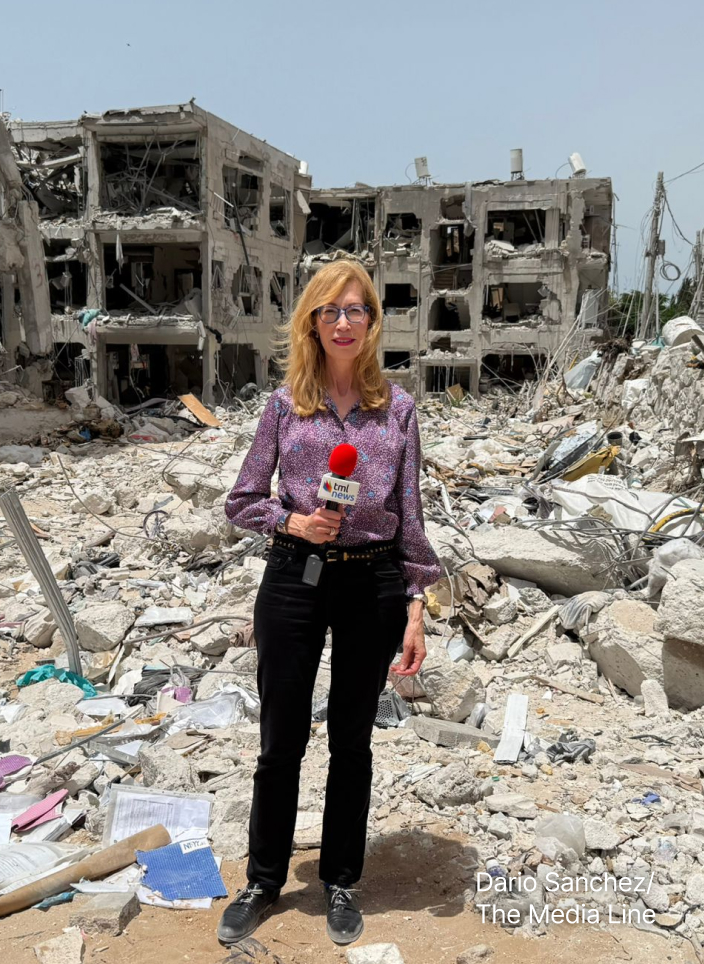

Gaza is in ruins, and I want to be part of rebuilding it
Another student, Sama Ahmad, also told The Media Line that she began university in 2023 just before the war upended her plans. Her family lived in the al-Rimal neighborhood, one of the first areas hit. “We were displaced right away,” she said. “Even with the destruction, the hunger, and having no safe place to stay, I kept studying.” With internet access weak or down, she walked long distances to find a signal. “Thank God I earned a score of 95%,” she said. After originally planning to study history, she chose information technology “to raise the name of Palestine.” Returning to the surviving university buildings “felt unreal, like a dream,” she added. “The buildings around are destroyed, but the university is still standing, and that gave me hope that we can still build something, even here in Gaza.”
The war has disrupted professional careers as well as undergraduate dreams. Muhammad, a master’s student in dentistry, told The Media Line he came to Al-Azhar to present his thesis in a campus marked by visible blast damage. “You can see the damage around me, and you know how hard the situation is, but I still want to continue my studies,” he said. His childhood dream of becoming a dentist nearly collapsed when doctors were arrested, clinics destroyed, and the university itself hit. He considered leaving for Egypt and looked for scholarships abroad. “But when the university here welcomed me back and encouraged me to register again, something changed,” he said. “I told myself, as a dental student, maybe I can still build a future here, close to my family, close to my friends, if we work hard and the situation improves.”
Beyond the university gates, debates over the Trump plan, the ceasefire, and Gaza’s political future are sharpening. “What happened is simple. People were never given answers,” Abu Hassan told The Media Line. “The negotiators didn’t explain what was agreed to, why certain conditions were accepted, and what the next steps would be. People feel completely in the dark.” Many Gazans, he said, turn to Israeli media and analysts such as Hassan Abu Zaid “just to understand what’s happening today and what might happen tomorrow.”
Others see short-term stability but no real solution. “I think the ceasefire will hold for a while,” Abu Mohamed told The Media Line. From his perspective, Israeli Prime Minister Benjamin Netanyahu and his party “gained more politically from this war than they lost.” Israel, he said, has “paid a heavy price in the eyes of the world,” which many in Gaza attribute to “the steadfastness and sacrifices of the Palestinian people.” He warned that if no substantive political outcome follows, “we could easily find ourselves in the same cycle all over again.”
Views on Gaza’s future governance vary widely. One resident, identified as B., told The Media Line that foreign administration of Gaza is unacceptable. “We reject any foreign government. We don’t want an international force or an outside authority coming in to run Gaza,” he said. “What people here want is a Palestinian government that brings all factions together and serves the interests of Palestinians.” Outside powers, he said, should “step aside and let us govern ourselves,” while providing support for reconstruction. “If a new Palestinian government takes shape and it fails, the people can replace it. We’ve proven our resilience.”
We reject any foreign government. We don’t want an international force or an outside authority coming in to run Gaza.
Another resident, C., told The Media Line that any future plan will require coordinated international involvement alongside the Palestinian Authority (PA). “The Gaza Strip is facing an enormous challenge,” he said. “The Palestinian Authority can’t handle reconstruction on its own, and neither can any single Arab nation or even the Gulf states.” Rebuilding housing, infrastructure, hospitals, and sending patients abroad “demands global support, not the resources from one country or one organization.” After nearly 20 years of separation between Gaza and the West Bank, he said, restoring functioning state institutions “will take international involvement alongside the PA.”
As these debates continue, many families remain in makeshift shelters. “Look at where we’re living. Look at this life. It’s water on top of water, mud everywhere,” said F., who also told The Media Line he is sheltering in a tent camp. “There’s nothing here. No real blankets, no doors, no furniture.” He described collecting scraps of wood to build something “that feels like a shelter,” unable to afford even plastic sheeting. “I don’t know if my wife will ever see a real home again, or if my child will grow up knowing anything beyond this mud.”
These voices from Gaza’s universities, shelters, and crowded streets reveal a society caught between exhaustion and determination. The long war, first sparked by Hamas and reshaped by President Donald Trump’s plan and international diplomacy, has left many Gazans unsure whether normal life is still possible. For now, they continue to study, rebuild, and debate the future, even as the path ahead remains uncertain.
