
‘When They Rise to Kill Us, We Must Rise to Defend’: Israelis Celebrate Purim in Shelters as War With Iran Unfolds
As missiles fall and shelters fill, Israelis mark Purim as their chief rabbi frames the war with Iran through the story of ancient Persia
In Beit Shemesh, just west of Jerusalem, children in bright costumes moved between apartment buildings carrying baskets of sweets when a siren interrupted the music. There was no shouting, no chaos. Parents pulled their children close and moved toward the reinforced rooms, some still clutching baskets that had not yet been delivered. A few costumes dragged slightly on the pavement as they walked. Inside, the usual Purim noise gave way to the familiar silence of waiting. When the all-clear finally came, people did what they had learned to do over the past days. They stepped back out and continued where they had stopped.
That rhythm has repeated itself across the country. In synagogues and apartment buildings, the Megillah is being read wherever there is concrete overhead and a door that seals properly. Music plays, stops for a siren, then resumes.
Purim marks the survival of the Jews in the Persian Empire, as told in the Book of Esther, also known as the megillah. This year, the reference to Persia does not feel historical. Israeli and American aircraft are striking targets in Iran, and Iranian missiles are reaching Israeli cities. The connection requires little elaboration. The parallel is not theological for most Israelis. It is geographic and immediate.
In Beit Shemesh, it also became literal.
An Iranian missile hit the city, killing nine people and leaving many others wounded. In the same strike, a fragment tore through a Torah scroll. Israeli journalist Amit Segal later posted an image of the damaged scroll on X, showing that the shrapnel had pierced the parchment at the passage commanding Jews to remember Amalek.
For Rabbi David Lau, former chief rabbi of Israel, the incident was not symbolic in a literary sense. It was simply a stark image of the moment. Rabbi Lau told The Media Line that Purim begins with a recognition of hatred in its most stripped-down form. “In Purim, you must remember one thing,” he said. “There was an awful hatred. An awful hatred in which Haman, instead of relating to people as people, measured an entire nation in silver.”
In Purim, you must remember one thing; there was an awful hatred in which Haman, instead of relating to people as people, measured an entire nation in silver
The biblical detail, he explained, matters. “I do not think there is a person who has a price. There is no such thing as measuring a human being in money. He measured an entire nation in money. That shows contempt. That shows hatred. That shows that in his eyes, those people had no value.”
From there, Rabbi Lau moved directly to the present. “You see a Persian nation today behaving in the same way,” he said, referring to Iran’s leadership. “A country that has severe problems of livelihood, of water, of electricity, millions who have nothing to eat. And instead of investing in their own people, they invest in war. They invest in Hezbollah. They invest in the Houthis. They invest in attempts to destroy and kill an entire nation.”

Megillah reading in an underground parking lot in Tel Aviv, March 2, 2026. (credit Jessica Cohen)
He was careful, however, to separate regimes from populations. The Megillah, he stressed, did not permit revenge against innocents. “All that the Megillah allowed the Jews to do was not to kill randomly,” he said. “Only those who rose against them. It was permitted to fight back against those who stood up to destroy them.”
That line, he suggested, remains the framework. “The people of Israel are not against the Iranian people. Not at all. The State of Israel is not against the Yemeni people, not against the Lebanese people. Only within those countries are individuals who hate the Jewish people and do everything against them. If someone truly rises to kill you, then it is permitted and necessary to fight back.”
Give the gift of hope
We practice what we preach:
accurate, fearless journalism. But we can't do it alone.
- On the ground in Gaza, Syria, Israel, Egypt, Pakistan, and more
- Our program trained more than 100 journalists
- Calling out fake news and reporting real facts
- On the ground in Gaza, Syria, Israel, Egypt, Pakistan, and more
- Our program trained more than 100 journalists
- Calling out fake news and reporting real facts
Join us.
Support The Media Line. Save democracy.


Those words are being tested in real time. The war itself began only days earlier. On Feb. 27, President Donald Trump gave final authorization for what Washington named Operation Epic Fury. By the next morning, the region was already in motion. Israeli and American aircraft were operating over Iran, striking missile sites and command facilities. News from Tehran began circulating quickly, including reports that Iranian Supreme Leader Ayatollah Ali Khamenei had been killed. Within hours, sirens sounded in Israel as ballistic missiles and drones were launched in retaliation, some aimed at US installations in the Gulf. The exchange has since cost at least six American service members their lives.
For families in Beit Shemesh, those developments were not distant updates scrolling across a screen. They were the reason Purim looked different this year.

Pupkin Family. (Courtesy)
Daniel Pupkin, a resident of the city, told The Media Line that no one in his neighborhood considered canceling the holiday outright. What changed was the scale and the logistics. His community had planned a Purim meal for roughly 400 people. Security directives made that impossible. Instead, families divided into smaller groups of about 20, making sure each gathering was within walking distance of a shelter.
“The war won’t stain the happiest day of the Jewish calendar,” Pupkin said. “No king, no fanatic will come and ruin a celebration that is 2,500 years old.”
The war won’t stain the happiest day of the Jewish calendar. No king, no fanatic will come and ruin a celebration that is 2,500 years old.
His six children dressed early in the morning. Five daughters chose matching Minion costumes. His youngest son dressed as a king. They carried mishloach manot (baskets of sweets) door-to-door until a siren sounded during one visit. Everyone moved into the reinforced room, waited about 10 minutes, recited blessings, and then continued.
“If you make the war a big deal, they will be afraid,” Pupkin said. In their neighborhood, even the alert system’s recorded warning has been turned into an AI-generated song that children sing with ironic enthusiasm. The humor does not erase the danger, but it changes the tone.
Pupkin does not dismiss the historical parallel, either. “We celebrate in Purim the end of Haman, of Amalek, and of the king of Persia,” he said. “That is exactly what is happening now. A person who wants to destroy the Jewish people, who says he is ready to destroy the only Jewish state in the world.” He referred directly to Khamenei, emphasizing that for many Israelis, the confrontation is tied to identifiable leadership rather than abstract geopolitics.
In Tel Aviv, the atmosphere is different but the substance is similar. Jessica Cohen, an Israeli-Argentinian activist living in Tel Aviv, told The Media Line that this war feels heavier than previous rounds. “These are ballistic missiles,” she said. “Not the same missiles that Hamas sends. People are much more worried. They go down to underground shelters. People are sleeping in shelters so they don’t have to wake up and run.”
People are sleeping in shelters so they don’t have to wake up and run
She described more than 20 alerts on the first day alone. The volume, the range, and the use of drones have extended the time residents must remain underground. Yet Purim gatherings have not disappeared. They have relocated.
At a Megillah reading held in a subterranean level beneath Dizengoff Center, Cohen said hundreds crowded into a protected space. There was music, dancing, and clowns. “There were more than 500 people in that shelter,” she said. With public parties prohibited, celebrations have moved into parking garages and fortified areas. “We celebrate how we can,” she said. “If we can’t celebrate outside, we celebrate inside.”
She herself has been sleeping in a minus-three parking garage with friends because her apartment’s safe room lacks a door. “When the alarm goes off at 3 in the morning, you can turn it off and go back to sleep, because you’re already in the shelter,” she said. What would normally be an inconvenience has become routine.
Municipal authorities are adapting as well. Assaf Weiss, deputy mayor of Ramat Gan, told The Media Line that the war began just as children were preparing their costumes. “This war, which is among the most justified of our wars, caught us exactly on Purim,” he said. “I have two daughters at home who were so excited to go to school and kindergarten in their costumes.”
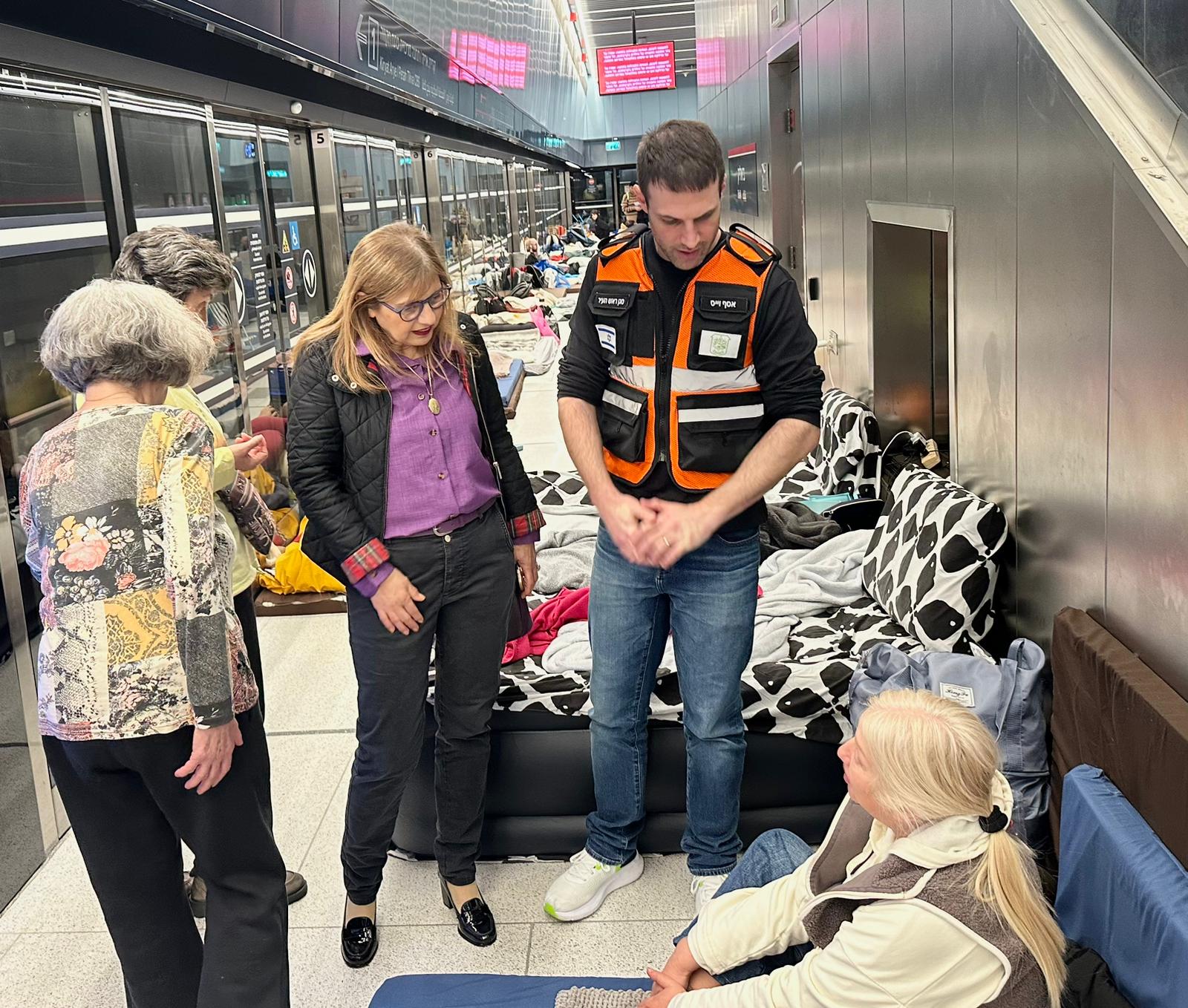
Assaf Weiss and Edna Vidal visiting citizens in the underground light rail. in Ramat Gan. (Omri Bram)
Large public events were canceled in accordance with Home Front Command guidelines. But the municipality organized smaller activities in approved shelters and protected spaces. There were Megillah readings with clowns and music in areas where families were already staying. Arcade machines were brought into shelters for children spending extended hours underground. Online events were held daily, including a Purim-themed Zoom rave for children who could not gather in person.
The city also deployed decorated trucks, approved to circulate under security regulations, that drive slowly through neighborhoods, playing Purim songs and carrying balloons so residents can watch from balconies and windows. Weiss said he had just left a missile impact site before passing one of the trucks on his route. “From a point of impact, where there are injured and property damage, to a joyful truck that does good for the soul,” he said. “That is our routine now.”
Rabbi Lau sees continuity rather than coincidence. He mentioned historical moments that fell on Purim, including Stalin’s stroke and the defeat of Saddam Hussein. “And Khamenei is the third,” he said. For him, the calendar carries memory.

Megillah reading in an underground parking lot in Tel Aviv, March 2, 2026. (credit Jessica Cohen)
“When the month of Adar enters, we increase in joy,” he said. “All the enemies of the Jews will know that in the end, even if it seems to them that they are succeeding, the people of Israel live.”
He also pointed to another line from the Megillah, describing Jews as “scattered and dispersed.” “You find Jews not only in the State of Israel, but dispersed throughout the world,” he said. “It is time to come home.”
Back in Beit Shemesh, the damaged Torah scroll remains where it was struck. No official declaration has elevated it into a national symbol. It does not need one. The image stands on its own: metal fragments cutting into parchment that speaks of memory, vulnerability, and defense.
Purim this year is being celebrated inside shelters, in underground garages, and in smaller circles than usual. It is louder in some ways, quieter in others. The sirens interrupt the singing, but they do not end it. For many Israelis, the story being read aloud is no longer distant history. It is part of the same week’s news cycle. And when the all-clear sounds, the doors open again.
