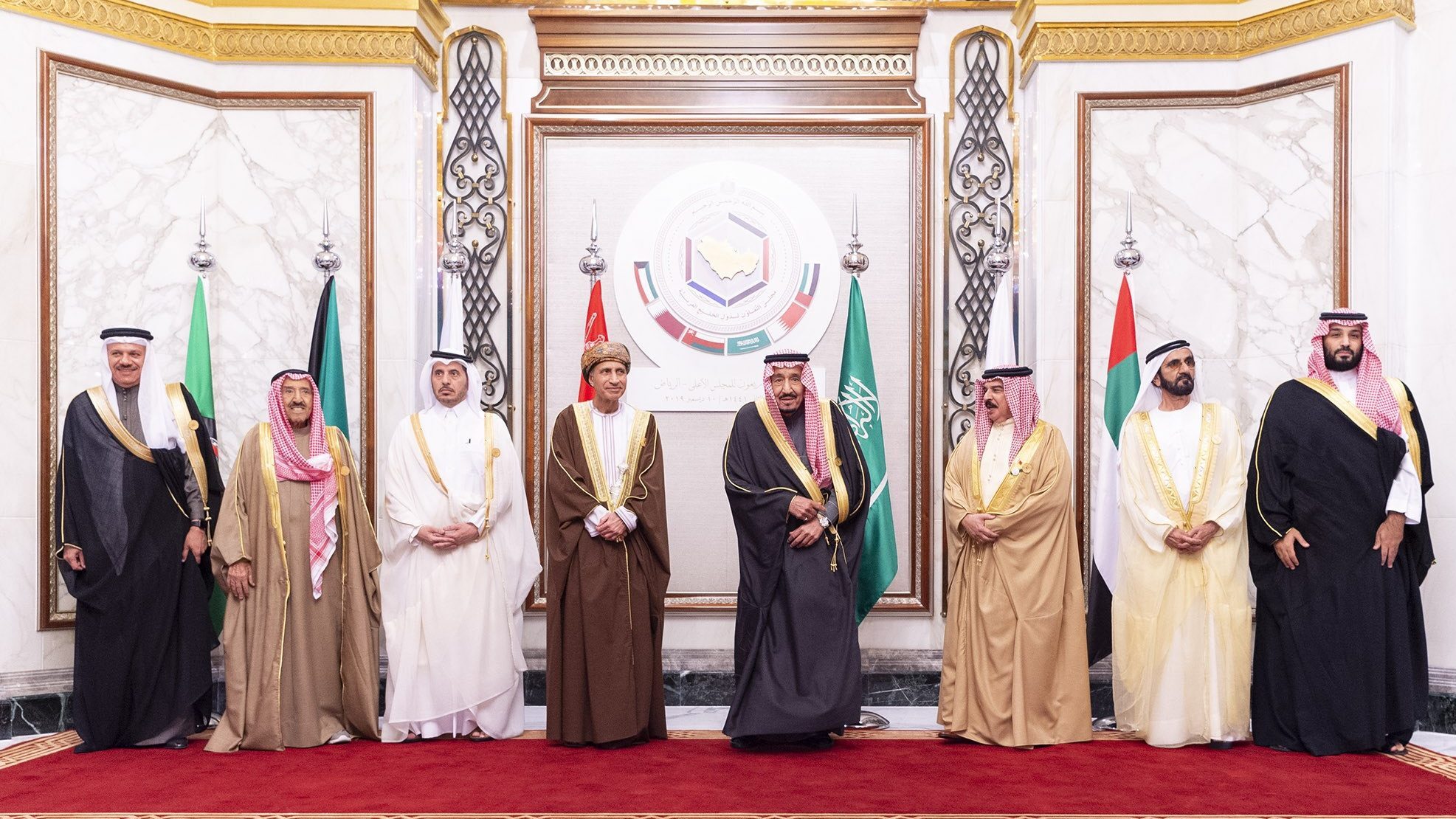
Why Some GCC States Fear the Fall of the Iranian Regime
Bahrain backs tougher action, while Saudi Arabia, Qatar, and Oman try to dissuade Washington from striking Iran
Anxiety is growing in the Gulf Cooperation Council (GCC) after US President Donald Trump escalated threats of a US military strike against Iran last week. Although no strike occurred, the US is building its military presence in the region, indicating preparations for potential action.
Four of the six GCC states—Saudi Arabia, the United Arab Emirates (UAE), Qatar, and Oman—oppose any US military strike that would topple the Iranian regime. Of these, Saudi Arabia, Qatar, and Oman have actively sought to dissuade Trump from launching a war against Iran, as reported by international media and not denied by the three countries.
Bahrain, however, takes an opposite stance, hoping a strike would eliminate Iran as a direct threat to its security. Kuwait has remained silent to avoid conflict.
Gulf states opposing a war share similar reasoning on certain aspects of the potential conflict. First, most Gulf oil exports pass through the Strait of Hormuz, representing 20% of global oil consumption. Any disruption to the strait or any hostile actions against oil tankers and giant commercial vessels would harm Gulf exports and directly impact national finances.
The Gulf states rely heavily on oil exports to fund their budgets, which account for more than 50% of their economies. Any military strike against Iran raises concerns among the Gulf states about a potential retaliatory attack by the Islamic Revolutionary Guard Corps (IRGC) against oil tankers, especially given the widespread presence of IRGC units and vessels in the Arabian Gulf.
There is also a fear that a strike or confrontation could escalate into a wider Middle East crisis. Because the region is already fragile, that escalation could bring more instability and, in turn, more economic damage at a time when the global economy is shaky, and Gulf governments are trying to maintain domestic growth numbers.
Additionally, if US forces use bases in the region to strike Iran, Gulf leaders are concerned that Iran-linked sleeper cells inside their countries could retaliate by attacking those same bases. If the Islamic Republic did decide to respond, the Gulf coast, only 300 kms from Iran, would be within range of Iranian ballistic missiles.
Several Gulf states also oppose removing the Iranian regime because they distrust Reza Pahlavi, the son of Iran’s former Shah, who was considered the “policeman of the region.” They recall that, after being deposed, his father acted with hostility and arrogance toward the Gulf states, treating them as his backyard.
There is also limited confidence in Iranian opposition leader Maryam Rajavi, whom some Gulf states see as holding a hardline Persian ideology and who, they fear, could take a hostile stance if she came to power.
The best option for the Gulf states is a compliant Iran, without risking the rise of a new hardline president or one whose future political direction is unknown
Majid Al-Abbasi, a researcher in political history, told The Media Line that the fall of the Iranian regime would destabilize the region’s security and politics, “and might create chaos that would take years to resolve. Therefore, they [the Gulf states] do not want this regime to fall.”
In his view, “the best option for the Gulf states is a compliant Iran, without risking the rise of a new hardline president or one whose future political direction is unknown.”
Give the gift of hope
We practice what we preach:
accurate, fearless journalism. But we can't do it alone.
- On the ground in Gaza, Syria, Israel, Egypt, Pakistan, and more
- Our program trained more than 100 journalists
- Calling out fake news and reporting real facts
- On the ground in Gaza, Syria, Israel, Egypt, Pakistan, and more
- Our program trained more than 100 journalists
- Calling out fake news and reporting real facts
Join us.
Support The Media Line. Save democracy.
He added there was a perceived risk that “Iran might witness a large exodus of Arabs from the coast, and Baloch [an Iranic ethnic group], towards the Gulf states, especially given the many shared family ties, which would mean an additional and unwelcome influx of refugees.”
The Saudi position rejecting war on Tehran comes about after nearly three years of a Saudi-Iranian reconciliation brokered by China. This resulted in a period of relative calm between Saudi Arabia and Iran and a cessation of the Saudi-led war in Yemen, in exchange for a halt to Houthi attacks on Saudi targets.
Saudi Arabia has suffered from such attacks since launching its coalition in early 2015 to support the legitimate government in Yemen and eliminate the Houthis. Since then, thousands of ballistic missiles and drones have been launched at Saudi oil, military, and civilian targets. Saudi Arabia also sees the overthrow of the Iranian regime—and the use of regional military bases to bomb Iran—as an opportunity for Tehran and the Houthis to strike those bases under the pretext of repelling a military threat, causing significant losses and economic weakness.
Commenting on the Saudi position, Saudi political researcher Nasser Al-Dossari told The Media Line that Saudi Arabia has long been working to resolve the region’s problems.
“This isn’t just about Saudi concerns. Saudi Arabia sees the necessity of resolving the region’s problems, which have been simmering for nearly 100 years and have never witnessed complete stability,” he said.
This isn’t just about Saudi concerns. Saudi Arabia sees the necessity of resolving the region’s problems, which have been simmering for nearly 100 years and have never witnessed complete stability.
“It also rejects the idea of the region becoming a battleground between America and Iran, or between America and its allies, including Russia and China, and Tehran. This would mean the region would become an open war zone with all possibilities,” he added.
Qatar and Oman maintain very close relations with the Iranian regime. Both countries consider Iran a strong and reliable ally and have long enjoyed good relations with it. Qatar has tried to use its relationship with Iran to bolster its position in the region and achieve its ambitions by gaining political ground at the expense of Saudi Arabia and the UAE.
The Sultanate of Oman—which previously hosted Iranian nuclear negotiations with the administration of former US President Barack Obama that led to the Iranian nuclear agreement and also hosted talks between Saudi Arabia and the Houthis in a mediating role—believes the fall of Shiite Iran would mean the dominance of Sunni Saudi Arabia. Oman, which follows the Ibadi school of thought, sees that outcome as potentially threatening, given the doctrine’s significant differences from Sunni religious teachings.
Dr. Hashem Al-Bajani, a retired professor of political science, explained his understanding of the situation to The Media Line, saying that Oman has enjoyed a strong relationship with the Iranian regime since it came to power in 1979. “Qatar and Oman consider Iran a vital lifeline in countering the expansion of Saudi influence. Iran was a good ally for Qatar during the Gulf boycott crisis, which saw Saudi Arabia close its land borders with Qatar. The closure lasted from June 2017 until the signing of the Al-Ula Declaration in early 2021.”
He added that Iran had stood by Oman against the Saudi religious revival, which for more than 20 years had targeted Oman’s official Ibadi school of thought during the “religious awakening” Saudi Arabia experienced beginning in the 1980s.
In contrast, the UAE’s refusal to support regime change in Iran and its desire to maintain the status quo despite sanctions on Tehran stem from its role as a transit hub for $50 billion in Iranian goods annually, both exports and imports. The UAE is Tehran’s second-largest trading partner.
If the Iranian regime were to fall, ships currently docking in the UAE to load goods destined for Iran would instead dock directly at Iranian ports on the opposite shore, resulting in significant losses and missed opportunities. However, the UAE could also benefit from direct investments should the Iranian regime collapse and either Maryam Rajavi or the Shah’s son assume power in Iran.
Economic analyst Abdulrahman Matar told The Media Line that Dubai and Abu Dhabi are important hubs for Iranian goods. “Iranian traders operating in Dubai represent approximately 20% of the city’s business volume, according to unofficial statistics. If the Iranian regime falls, these traders will be able to conduct their business directly from Iran, instead of using Dubai as an alternative base,” he explained.
If the Iranian regime falls, these traders will be able to conduct their business directly from Iran, instead of using Dubai as an alternative base
“The UAE has repeatedly refused to take hostile stances against Iran, even during the Gulf crisis with Iran, which began after the Tehran regime supported attempts to destabilize Bahrain in 2011, and then the Saudi-Iranian dispute that arose following the attacks on the Saudi embassy in Tehran in 2016.”
Bahrain might be the country that stands to gain the most from the fall of the Iranian regime. The IRGC has worked since the 1980s to destabilize Bahrain, using its loyalists among the Shiite population, which constitutes nearly half of Bahrain’s citizens.
Repeated crises and fierce clashes happened in Bahrain between armed Shiite groups trained by the IRGC in the 1980s, 1996, and 2011. These were the largest confrontations aimed at overthrowing the Bahraini regime and either declaring Bahrain an Islamic republic modeled after Iran, or annexing it as an Iranian province.
Over the past two decades, Iran has supported more than 20 armed movements with weapons, training, and funds. These movements have carried out terrorist operations within Bahrain, with Bahraini leaders repeatedly accusing the Iranian regime and the IRGC of attempting to undermine its security and stability.
Although the Shah’s regime demanded that Bahrain be part of Iran, it yielded to the “Arabism of Bahrain” referendum held in 1970, in which the people of Bahrain affirmed that Bahrain was an independent Arab state, not subservient to the Iranian regime.
Bahrain, along with Saudi Arabia, severed ties with Tehran in 2016, and relations with Iran were not restored following the Saudi-Iranian reconciliation in 2013. The diplomatic rift between Bahrain and Iran persists to this day, despite some minor efforts to reach political understandings that have yet to yield results.
Saad Al-Hajri, a political analyst, told The Media Line that Bahrain has repeatedly called for relations with Tehran to be based on good neighborliness and non-interference in the affairs of other countries, but that this has not actually happened since Khomeini came to power in Iran in 1979.
Iran has always sought to incite unrest among Bahrain’s Shia population. … However, all these attempts have failed miserably.
“Iran has always sought to incite unrest among Bahrain’s Shia population, supporting thousands of Shia individuals by training them in weapons and explosives manufacturing, and instructing them to target government buildings and institutions. However, all these attempts have failed miserably, achieving nothing but a few bloody incidents,” he said.
Since Emir Mishal Al-Ahmad Al-Jaber Al-Sabah assumed power in Kuwait in 2023, he has been working to reform the domestic front. He dissolved parliament, reviewed citizenship issues, and combated corruption. However, Kuwait’s international standing has become more subdued, and it has distanced itself from international influence while it works to resolve its internal issues.
