OPINION – Jewish Identity and the Current State of New York City Politics
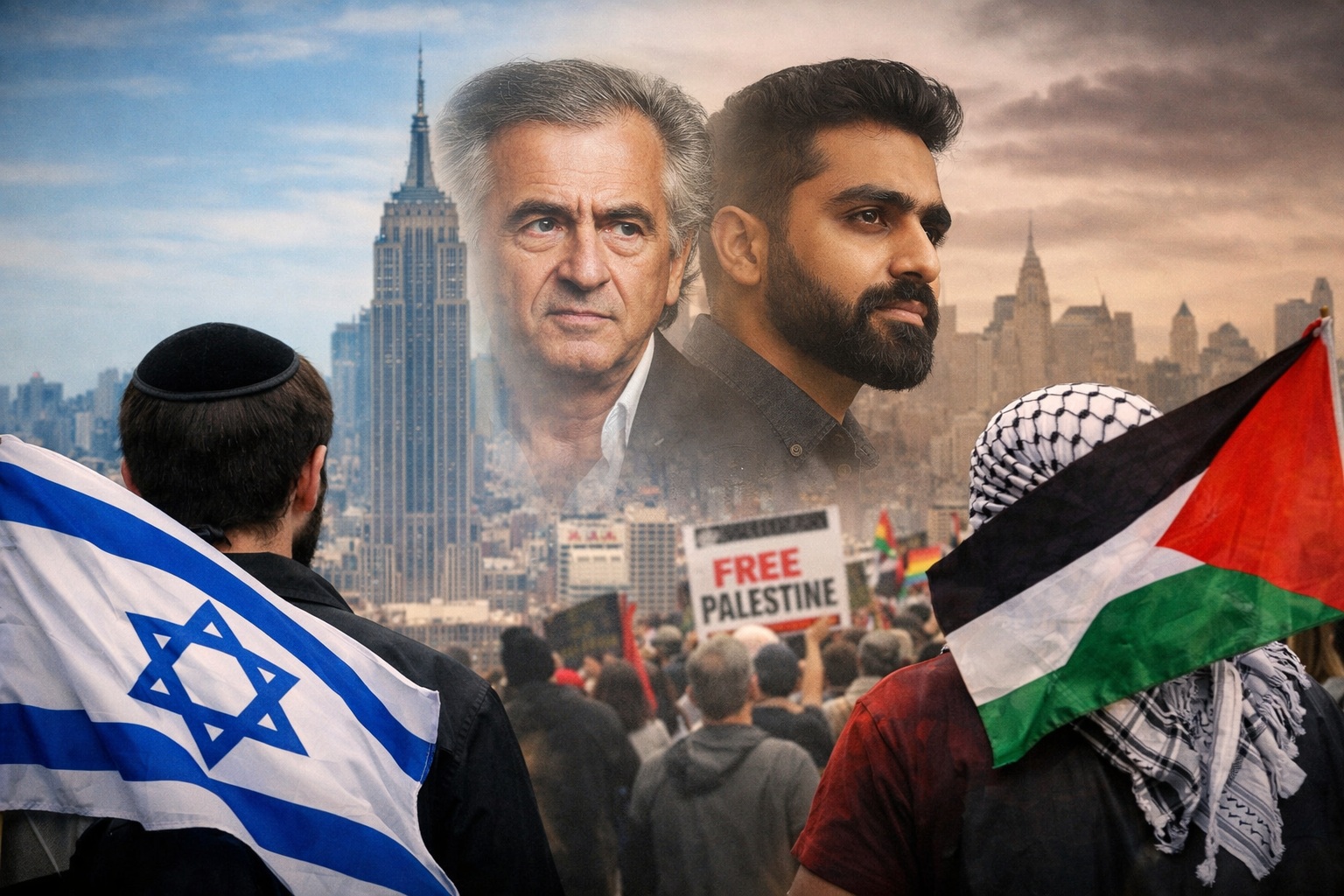
I had the privilege, some 20 years ago, of hearing Bernard-Henri Lévy, the French Jewish philosopher, argue that the central challenge to universalism—as a worldview, a set of values, and a political commitment—was not necessarily a tension between universal values and particularism. Rather, it was a tension between two different notions of universalism: one that is built on the particular and one that negates the particular. In that framework, the universalism of the French Revolution demanded that Jews negate their particularism and peoplehood to enjoy liberty and equality. They had to hide as Jews in order to be equal and free.
An alternative vision holds that different peoples, nations, ethnicities, communities, and cultures can affirm themselves within a universal framework that celebrates difference—so long as one group’s particular identity does not negate another’s, but instead affirms all peoples as limbs in the body of humanity. I was reminded of that tension recently while listening to New York City Mayor Zohran Mamdani’s inaugural speech, when he asserted, to loud applause, that Palestinian New Yorkers in Bay Ridge, Brooklyn, can look forward to a time under his mayoralty when they “will no longer have to contend with a politics that speaks of universalism and then makes them the exception.” I was reminded of Lévy’s argument not because I found the mayor’s logic persuasive, but because I found it puzzling.
Are New Yorkers of Palestinian background uniquely excluded from the rights and privileges of being Americans in New York? Are they not permitted to affirm a Palestinian identity in a way that also affirms the identities of others, including Jews and Israelis? That is hard to fathom. I am not aware of Palestinian self-affirmation being questioned in New York politics except when it crosses into negating Israeli or Jewish affirmation—for example, in chants of “from the river to the sea” or “globalize the intifada” at protests organized by Palestinian activists, including marches of hundreds of demonstrators up Columbus Avenue on the Upper West Side, apparently chosen because the neighborhood has a large Jewish population.
Alternatively, was the new mayor referring to the status of Palestinian Arabs in Israel and the territories and connecting that—somehow—to the policies of the City of New York? Which city policies have excluded Bay Ridge Palestinians, or Palestinians more broadly, from the promises of universalism? All three of Mamdani’s most recent mayoral predecessors, going back 24 years, are on record supporting a two-state solution and self-determination for Palestinian Arabs, on the condition that they live alongside a secure and independent Israel. Or perhaps, for Mamdani, the two-state solution itself denies Palestinians the promise of universalism because his vision of Palestinian national affirmation cannot abide a Jewish Israel next door. What, exactly, is he promising the roughly 9,000 New Yorkers of Palestinian background in Bay Ridge that he does not also need to promise the roughly 19,000 Jewish New Yorkers who live in the same neighborhood and who, in his view, have not been excluded from universalism?
Give the gift of hope
We practice what we preach:
accurate, fearless journalism. But we can't do it alone.
- On the ground in Gaza, Syria, Israel, Egypt, Pakistan, and more
- Our program trained more than 100 journalists
- Calling out fake news and reporting real facts
- On the ground in Gaza, Syria, Israel, Egypt, Pakistan, and more
- Our program trained more than 100 journalists
- Calling out fake news and reporting real facts
Join us.
Support The Media Line. Save democracy.
To begin answering that, consider a series of statements Mamdani has made about Jews and Israel that suggest a distinctive stance toward the Jewish particular and its place within universalism.
During the campaign, Mamdani repeatedly said he could not support Israel’s right to exist as a Jewish state because he would not recognize the right of any state to define itself through a hierarchy based on race or religion—whether Israel or Saudi Arabia. Yet he has expressed no comparable objection to the Church of England’s status as the established church in England, nor has he shown any particular concern about the Vatican’s religious sovereignty. Nor does the constitutional privileging of Islam in Pakistan appear to trouble him when he celebrates Pakistan’s Independence Day with Pakistani New Yorkers and when he travels there.
A more basic question follows: Why does Mamdani define Jewishness as either a race or a religion? Why does he confine Jewish collective identity to those two options? Jewishness is historically multidimensional, combining religious and national elements—faith and peoplehood (though not “race” in any coherent biological sense). For a Muslim American of Indian descent, born in Uganda, to cast Jewish identity as either religion or race is to impose a false binary on someone else’s identity. Mamdani seems willing to tell Jews who they are—and to do so from the bully pulpit of the New York City mayoralty. The cultural imperialism involved in telling Jews what they can and cannot be contradicts his stated concern about Palestinians and universalism. He is careful to describe Jews and Jewishness in strictly religious terms, while invoking “race” largely to imply that Jewish peoplehood must either be reducible to religion or else be treated as inherently racist.
Even though the Nazis framed Jews as a distinct race—more specifically, a “mongrel race,” whatever that means—Jewishness has long been constituted through either familial lineage or conversion. That has been true in Jewish narrative terms since the Exodus from Egypt (see Exodus 12:43-49). Racial categories do not map cleanly onto Jewish identity. Jews who sat in exile in Europe look white. Jews who sat in exile in Morocco, Iraq, and Persia look brown. Jews who sat in exile in Ethiopia and even Yemen look black. What binds these communities is not race, but it is not exclusively religion either. It is multiracial peoplehood: an extended family with an open adoption policy, in which one can be born a Jew and one can also choose to become a Jew. Being a people is not being a biological race; it is something else. Jewish peoplehood is about birth and choice. It is about ancestry and faith. It is about nation and culture, language, and an interpretive wisdom tradition. It is not one thing or the other. When Jews do not fit neatly into Western categories of group identity, forcing them into those categories becomes its own form of cultural imperialism. In the end, what Mamdani is saying amounts to this: To the Jews as a religion, almost everything; to the Jews as a people, nothing.
Together with Jewish allies such as Peter Beinart and Brad Lander, Mamdani appears to treat Jewish sovereignty—political Zionism—as necessarily entailing Jewish supremacy and therefore as untenable and immoral. In that view, Zionism is always about conquest and suppression, never about self-determination, return, or independence—regardless of what Israel might do to accommodate its neighbors or pursue a settlement.
At a recent public forum at B’nai Jeshurun synagogue in Manhattan, Rabbi Jill Jacobs, who leads the Jewish social justice organization T’ruah, countered Beinart’s argument that Jewish sovereignty can only mean the brutal abuse and deprivation of Palestinians. She said that almost all nation-states are ethnostates, but that if they protect the rights of minorities, they need not lead to supremacy and oppression. She also argued that the American model of citizenship—grounded in universal values without regard to ethno-national identity—is the exception globally, implying that holding Israel to an American standard of identity and citizenship is not a fair comparison.
In her view, Israel can avoid the immoral outcome Beinart claims is the inevitable implication of Jewish sovereignty only through a two-state solution to the Israeli-Palestinian conflict. (Given October 7, 2023—and, for that matter, Aug. 23–24, 1929, in Hebron—that is no longer my view, but that is for a different day.) What stands out is that Mamdani appears to reject that possibility. The new mayor holds Israel to an impossible standard that denies Jewish self-determination altogether. As noted earlier, he celebrates Muslim countries such as Pakistan despite the constitutional hierarchy that privileges Islam and despite, for that matter, episodes such as Pakistan’s 1971 Operation Searchlight, during which hundreds of thousands of Bengali civilians were slaughtered in what can only be described as genocide.
Whatever regrets Mamdani may have about that kind of hierarchy or abuse, they do not seem to lead him to question the legitimacy of Pakistani statehood or national identity. With Israel, Zionism, and the Jews as a people, he takes a different approach. He appears willing to accept imperfection almost everywhere except Israel. That becomes the “exception” in the universalism he promises. Perhaps what he really meant by his Bay Ridge pronouncement is that, under his mayoralty, he will not burden Palestinians with any affirmation of Israel—or any expectation that they accommodate the Hebrew-speaking other. If so, what does that mean for Jewish New Yorkers? It means that Jews can look forward to being relegated to the universalism of the French Revolution in New York City politics rather than inclusion in the universalism of the multicultural agenda. No e pluribus unum for us.
