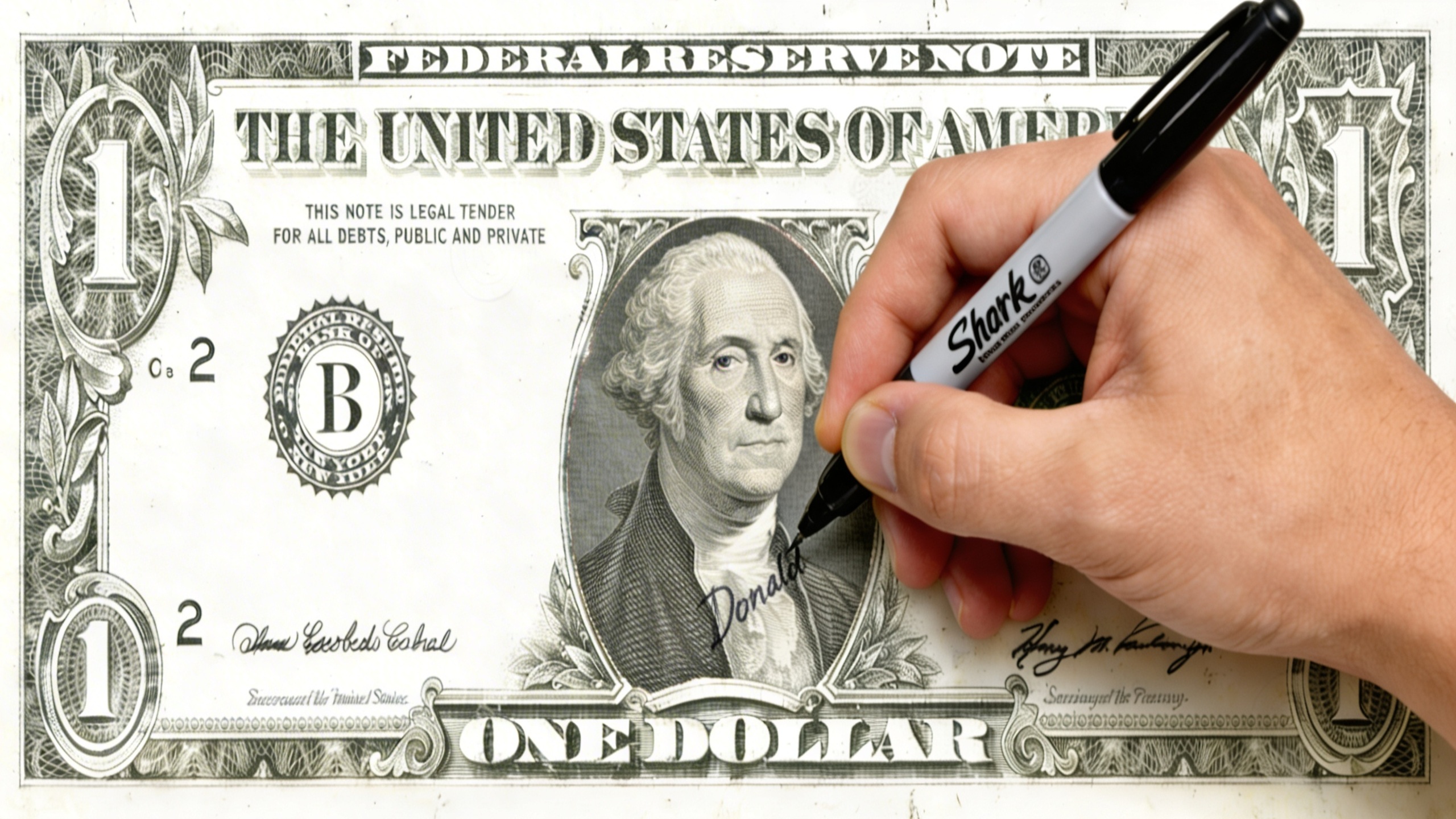
President Trump Puts His Mark on the Money
Americans may soon find President Donald Trump in their wallets even more often than on their television screens.
The Treasury Department said this week that new US paper currency will carry President Trump’s signature, ending a 165-year tradition under which paper notes bore the signatures of the Treasury secretary and the US treasurer. The first redesigned $100 bills are expected to begin printing in June, with other denominations to follow as part of the broader rollout tied to the 250th anniversary of American independence in 2026.
Treasury framed the move as a patriotic modernization rather than a monetary vanity plate. In its official announcement, the department said the change would align the currency redesign with “America’s Golden Age” messaging and the semiquincentennial celebrations now sweeping Washington. Treasury Secretary Scott Bessent called the new notes a symbol of “renewed American prosperity,” which is Treasury-speak for: yes, the signature is staying.
Give the gift of hope
We practice what we preach:
accurate, fearless journalism. But we can't do it alone.
- On the ground in Gaza, Syria, Israel, Egypt, Pakistan, and more
- Our program trained more than 100 journalists
- Calling out fake news and reporting real facts
- On the ground in Gaza, Syria, Israel, Egypt, Pakistan, and more
- Our program trained more than 100 journalists
- Calling out fake news and reporting real facts
Join us.
Support The Media Line. Save democracy.


The change is small in one sense. President Trump’s face is not replacing Benjamin Franklin, George Washington, or anyone else on the bills. Design elements and anti-counterfeiting features will remain in place, and the notes will still look like US currency rather than campaign merch. But symbolically, it is a tidy little revolution. Since 1861, the president’s signature has not appeared on circulating paper money, making this one of those obscure Washington traditions nobody thinks about until somebody breaks it with a gold Sharpie flourish.
Reuters notes that having a sitting political leader’s personal mark on currency puts President Trump in a fairly small and rather awkward club. It cites examples of leaders such as Mobutu Sese Seko of Zaire, Ugandan dictator Idi Amin, Julius Nyerere of Tanzania, and Ferdinand Marcos Sr. of the Philippines, whose images appeared on their countries’ money. Reuters also notes that Philippine peso notes now bear the signature of Ferdinand “Bongbong” Marcos Jr., the current president, making the Philippines one of the few modern examples where a sitting head of state’s signature appears on circulating currency.
There is also a Middle Eastern contrast worth noting. In much of the region, banknotes often carry the portrait of the ruler rather than the ruler’s signature. Current or recent examples include Oman, whose banknotes feature Sultan Haitham bin Tariq, while countries such as Jordan, Saudi Arabia, Morocco, Bahrain, Qatar, Kuwait, and the United Arab Emirates have long traditions of placing reigning monarchs or ruling emirs on their money in one form or another. That is a different tradition from putting the sitting political leader’s personal signature on the note itself, but the resemblance in political symbolism is hard to miss.
