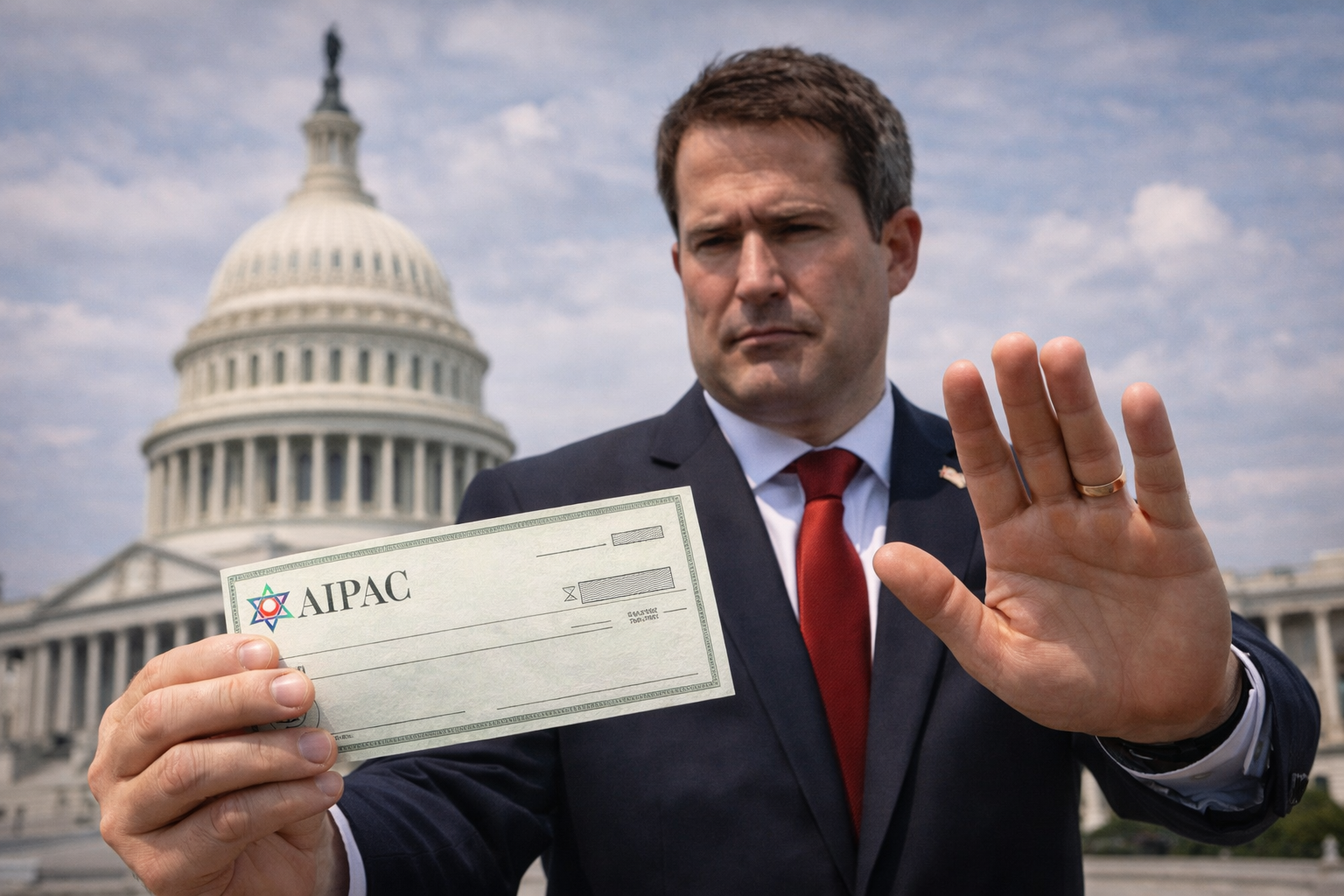
US Representative Moulton and AIPAC
Al Qabas, Kuwait, October 31
Democratic Representative Seth Moulton announced that he will return all donations previously received from AIPAC, the American Israel Public Affairs Committee, and refuse any future support from the lobby group. This marks perhaps the first prominent and public instance of a Democratic member of Congress taking such a stance. Because of its unprecedented nature, the move has drawn significant attention from political commentators, who describe it as historic and unparalleled in recent memory.
Moulton is the first representative of his stature to reject AIPAC’s backing and, moreover, to return all prior contributions. His decision is expected to encourage other members to follow suit.
The history of the Zionist lobby, on both sides of the Atlantic, reveals a long and meticulous evolution of religious and political advocacy. The beginnings of pro-Zionist lobbying in Britain can be traced to the early 19th century, when certain Christian and Jewish figures began promoting the “return” of Jews to Palestine. In 1839, evangelical leaders lobbied Parliament to support Jewish resettlement, and by the end of that century, figures such as Theodor Herzl and Chaim Weizmann were pressing senior British officials. The result was the Balfour Declaration of 1917, through which the British government, under the influence of Zionist leaders, pledged to support the creation of a “national home for the Jewish people” in Palestine.
Give the gift of hope
We practice what we preach:
accurate, fearless journalism. But we can't do it alone.
- On the ground in Gaza, Syria, Israel, Egypt, Pakistan, and more
- Our program trained more than 100 journalists
- Calling out fake news and reporting real facts
- On the ground in Gaza, Syria, Israel, Egypt, Pakistan, and more
- Our program trained more than 100 journalists
- Calling out fake news and reporting real facts
Join us.
Support The Media Line. Save democracy.


Until World War II, most mainstream Jewish organizations were, in fact, anti-Zionist, while Zionist lobbying worked through smaller, more targeted channels. Over time, however, support for Zionism grew—particularly after the Holocaust and the founding of Israel in 1948.
In the United States, Jewish pro-Zionist lobbying began in the early 20th century but became far more visible after World War II. The American Zionist Council was formed in 1949, uniting various Zionist organizations to lobby Congress and influence public opinion on behalf of Israel. In 1951, the American Zionist Committee for Public Affairs—later renamed AIPAC in 1959—began direct lobbying efforts, first through public relations and later through legislative influence. It quickly became one of Washington’s most powerful lobbying groups, reaching its zenith after the 1967 Six-Day War, which galvanized American Jewish support for Israel and deepened bipartisan lobbying efforts across the political landscape.
While Zionist lobbying groups in Britain and America often coordinate their messaging, each operates differently due to contrasting political systems and public attitudes. Historically, British Zionism has leaned more on elite influence, while American Zionism has relied on mass mobilization, fundraising, media engagement, and direct outreach to Congress.
Since the 1970s, Zionist organizations in both nations have forged close ties, frequently collaborating on policy strategy, communication, and crisis management. The Zionist lobby in both the UK and the US has thus evolved from its religious and diplomatic origins into a formidable political force—one that wields organizational skill, political access, and extensive activism; invests heavily in cultivating influence among lawmakers and other power brokers; and aggressively targets its critics.
In an unexpected turn, and for the first time in its history, AIPAC—its image tarnished by mounting global outrage over the genocidal campaign in Gaza—has launched an assertive advertising blitz emphasizing its patriotism and its self-portrayal as an American institution. The campaign stresses that its members are acting in what they claim are the best interests of the United States and that supporting Israel, they argue, remains sound American policy.
Ahmed Al-Sarraf (translated by Asaf Zilberfarb)
