Silence To Save the Hostages Today Is The Same Silence To Save the Jews From Nazis Back Then, Horn Family Says
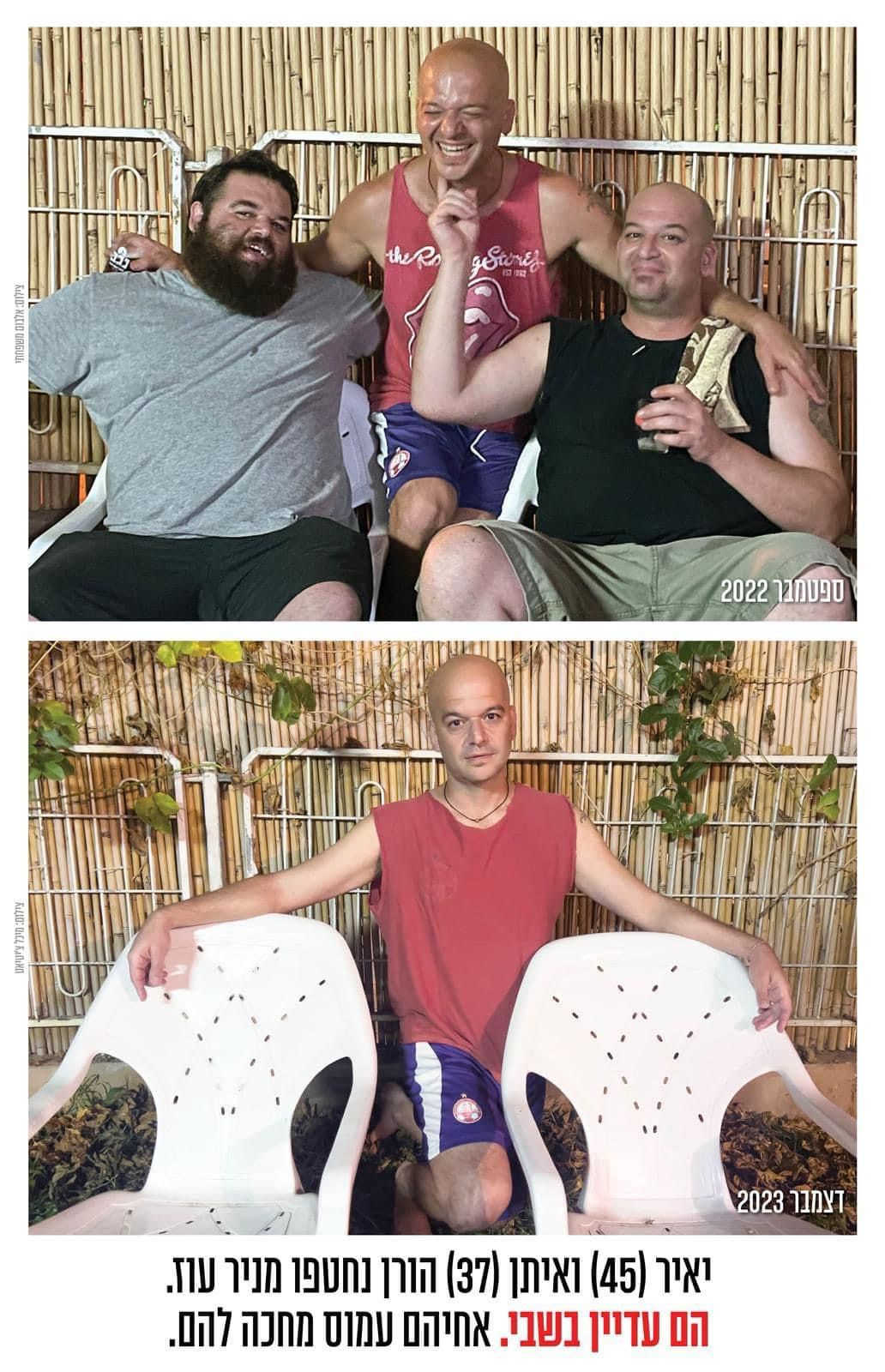
Eitan (37) and Yair (45) Horn are two of three brothers whose big smiling faces have been among some of the most recognizable hostage posters posted worldwide since October 7. They are also among the hostages who are thought to still be alive after 460 days in Hamas captivity in Gaza. However, despite a potential deal to free 39 hostages that is said to be imminent, the kidnapped Horn brothers were seemingly not contemplated as part of the negotiations.
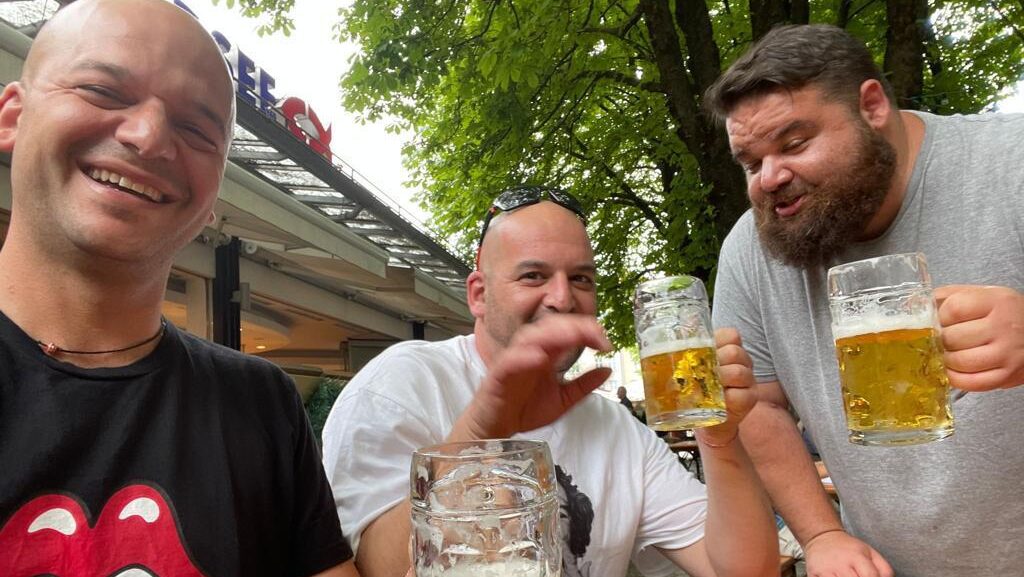
Eitan and Yair are known for their joyful attitudes toward life, their passion for soccer, and their love for The Rolling Stones, according to Dalia, whose husband is Amos Horn, the only Horn brother who remains free today. Speaking to The Media Line, Dalia shared the Horn family’s hope for the brothers’ return and dared the world to think: “What would you do if they were your brothers?”
TML: What changed in your life over the last 15 months since October 7?
Dalia: We maintain hope because we know they are fighting under the most inhumane conditions possible. They’ve been in a tunnel for 460 days without seeing sunlight, hungry, suffering psychological terror, and enduring severe physical violence, and since they are surviving, all we can do is fight in every possible way to bring them home. To be honest, there are mornings when we don’t want to get out of bed. My husband is the middle brother. He’s devastated; it’s like a triangle with two sides missing if that makes sense, and that’s what’s left of him. But at the same time, we understand that they are screaming in the tunnel, even if we can’t hear them, so we have to be their voice and the voice for everyone, not just for the two of them.

The Horn family (Courtesy)
TML: An agreement appears to be on the horizon to release 39 hostages. However, these kinds of agreements are not as frequent, and this one would still have more than 50 hostages still inside Gaza. What are your thoughts on recent updates?
Dalia: I don’t want to discuss the list that was published because, honestly, we don’t know exactly. It’s a list that Israel used in July when they were talking about an agreement that unfortunately failed, apparently due to the Israeli government, but we don’t know that for sure. So, I don’t want to comment on that list. I know they are negotiating now, and we’ve heard bits and pieces suggesting some optimism. But at the same time, until we see all of them at home—every single one, down to the last body—we won’t know what has actually happened. Our families are all united in the demand to bring everyone back. We understand that the agreement will likely happen in stages, and we accept that’s how it has to be.
However, we insist on knowing when the first will be released and when the last will be freed, and we will not stop until the end. Creating a list of ‘humanitarian cases’ after 15 months is absurd because they’re all humanitarian cases. Yair has diabetes, and Eitan has a severe skin condition, but after 15 months, everyone—women who were raped daily for 15 months, children—every single one is a humanitarian case.
That is why this is our demand, and we are terrified that the government might proceed with a small agreement without addressing the second part, what comes next. At the same time, we understand that we must rescue whoever can be rescued as soon as possible. It’s incredibly, incredibly complex, which is why we families say we are not experts in these types of negotiations; we are just relatives who want our loved ones back, from the first to the last.
TML: Could you tell me a bit more about Eitan and Yair? What are they like, their passions, their family bonds?
Dalia: They are the funniest people in the world, each in their own way. Eitan is very outgoing and extroverted. He’s the kind of person who walks into a place and can’t stand to see anyone sad, so he always has a good joke ready. And if there’s a microphone around, he’s the first to grab it and start singing or dancing. Yair was the first to make Aliyah. They grew up in an Argentinian family, a very Zionist home. Yair is the eldest; he finished school and made Aliyah to join the army, and then he began his life.
He wanted to be part of a community, so he went to live in Nir Oz, where he had a childhood friend. From the very start, Yair became like an uncle to all the kids in the kibbutz, and he’s someone everyone knows. Today, I was in the kibbutz with someone I didn’t know, and they said to me, ‘Yair is one of those people who isn’t officially part of anything but is everywhere, at every event, every party.’ He organizes the pub; Yair makes sure people come to the pub for karaoke nights or to watch football games together.
During COVID, when people were stuck at home, Yair wanted everyone to be together and have fun. So he grabbed beer and wine, put them on a golf cart, and drove around the kibbutz distributing drinks, encouraging everyone to step outside and break out of their bubbles.
Eitan, the youngest of the brothers, arrived at age 16 in Israel, finished high school here, and then joined the army. Eitan has always been drawn to leadership. In the kibbutz, in the youth movement, he went on a trip through the Jewish Agency to Peru.
He worked with many young people in various kibbutzim and even with children Israel brought over as refugees from the war in Ukraine. Eitan worked with them, and I remember telling him, ‘Eitan, you don’t know how to speak Russian or Ukrainian,’ and he said, ‘Come on, these kids are fleeing a war. I’ll be there for them no matter the language.’ So that’s who he is. And they are the best uncles.
My husband and I have two kids, aged 9 and 12, and they are the best uncles—so fun, so playful. They love taking the kids out, buying them things, and doing everything kids enjoy. Yair, Eitan, and Amos—my husband—are all huge fans of a football team, Hapoel Be’er Sheva, which is a southern team. Every Saturday, they would meet up, have a barbecue, and then head to the game. And if Hapoel Be’er Sheva played in Europe, they would travel there.
They share another passion: The Rolling Stones. They’ve attended several shows in different parts of the world. Last year, when Keith Richards turned 80, they knew there was going to be a tour, and it was rumored to be the last one. They were eagerly waiting for the announcement, but unfortunately, the tour was announced and came and went, and they missed it. But they are such good people, simple, humble, and just wanting others to be happy.

The Horn family (Courtesy)
TML: What did October 7 look like for you?
Dalia: We live in Kfar Saba, which is in the center of Israel, and Eitan, too. But Eitan had gone to visit Yair in Kibbutz Nir Oz, less than two kilometers from the Gaza border. On that Saturday, at six-thirty in the morning, the alarms sounded. We grabbed the kids and the phone and went to the safe room, and we called them, even though Yair always says that Nir Oz is so close to the border that most missiles fly over it. Still, we called, but they didn’t answer. They only sent a message saying they were in the safe room and everything was fine. Ten minutes later, we left the safe room, thinking we’d go back to sleep, and were on our way back to bed.
We turned on the news and started seeing images of terrorists walking along paths we know from the kibbutz. We didn’t understand what was happening and kept calling them, but they didn’t answer. However, they kept texting, either sharing jokes in their WhatsApp group with the three brothers or saying they were still in the safe room and everything was okay. They never mentioned terrorists or anything alarming. We received a message we didn’t know would be the last at seven-thirty in the morning. It said, ‘We’re still here, everything’s fine.’
We kept calling, but they didn’t answer. We sent messages and saw they weren’t delivered. We turned on the television and saw horrific images. I think we still couldn’t fully grasp what was happening.
Give the gift of hope
We practice what we preach:
accurate, fearless journalism. But we can't do it alone.
- On the ground in Gaza, Syria, Israel, Egypt, Pakistan, and more
- Our program trained more than 100 journalists
- Calling out fake news and reporting real facts
- On the ground in Gaza, Syria, Israel, Egypt, Pakistan, and more
- Our program trained more than 100 journalists
- Calling out fake news and reporting real facts
Join us.
Support The Media Line. Save democracy.

TML: What about your husband?
Dalia: We tried to stay rational, thinking their phones had run out of battery or there was no signal. Around noon, my husband grabbed the car keys and told me, ‘I’m going.’ I asked him, ‘Where?’ He said, ‘Something bad has happened to my brothers; I must rescue them,’ but I didn’t let him go. I told him he didn’t have a weapon and showed him on TV what was happening, explaining that if he went, he likely wouldn’t return, and I didn’t want my children to lose their father.
He became very upset and said, ‘If it were your brothers, wouldn’t you do everything for them?’ It was a very hard moment for me because, yes, I would do everything for my brothers and for Eitan and Yair, but I understood at that moment that Amos couldn’t go. Until nightfall, we kept calling friends at the kibbutz, asking if anyone knew anything and if they could look out the window. But everyone replied that they couldn’t; they had terrorists in their homes, and their houses were being burned down. That night, we began to understand they had disappeared. The first time we found out what had happened to them was on November 25, when some hostages were brought with the release agreement. The women and children from the kibbutz returned and called us, saying that Yair and Eitan were alive, uninjured, and being held in the tunnels. It was a moment of great relief.
And look how absurd it is, right? I mean, relief is knowing they are kidnapped? That’s not normal. At the same time, they told us about the hunger, the violence, the torture, and other horrific things. That was basically the first and last time we heard anything about them. We know they are alive. According to the army, they are part of the group of hostages still alive. And I know them. I know they are fighting and doing everything they can. And all we can do is bring this to an end and bring them back because this is not normal.
TML: Could they draw strength from each other, and has that helped them endure?
Dalia: I’m certain that their personalities help them survive—and also help others who are with them. Let me tell you something. The women who returned told us about some of the things Hamas did, and I think even the strongest and most joyful person in the world, after 460 days without seeing sunlight and experiencing hunger—not the kind of hunger we know but real starvation—would struggle.
The women said that Hamas terrorists told them that Israel had forgotten them, that no one cared, and that they should start learning Arabic because they weren’t going home. And when the women were released, before leaving, the terrorists looked them in the eyes and said, ‘Don’t go back to your kibbutz because we’ll do October 7 all over again.’
Now, these women were there for 52 days, and they said that even though they knew Israel was fighting for them, so much time had passed that they began to have doubts. Imagine now, 460 days later. They [Eitan and Yair] must be convinced they’ve been completely abandoned—how else could they understand that the world is doing nothing? The Western, democratic world, the Israeli government, the American government, the Argentinean government—they’re Argentinians, after all.
How can anyone accept a reality where civilians, including a nine-month-old baby, are kidnapped for nearly two years? I believe that bringing them back is not only about rescuing them but also about restoring to all Israeli citizens—and to the entire world—the sense that life, life itself, is the most important thing.
TML: Do you think they might have lost hope?
Dalia: I hope they still have hope. I always believe that hope is the last to go. I know they’re alive, and because I know they’re alive, I imagine it’s hope that keeps them going. But these are all questions they’ll answer when they return.
TML: Your family also has many bonds with Argentina. How do you evaluate the performance of the Argentinean government since October 7?
Dalia: I was surprised by their unconditional support for Israel, even before [Javier] Milei was elected president. [Former] President Fernández, in the first week of the war, held a Zoom conversation when there were still 26 Argentinian hostages and publicly stated in the press and various places in Argentina that Israel has the right to defend itself—something many other countries, unfortunately, didn’t do. Since Javier Milei was elected president, support for Israel has been greater than ever.
We all saw the reaction of the UN Secretary-General, the Pope, and the Brazilian president, for example. Unfortunately, many countries responded absurdly in ways that, to some extent, encourage terrorism with those responses.
We know Argentina is doing many things to try to help Israel, including regarding the hostages. I think it’s good to feel that we’re not alone. Part of the difficulty since October 7 has been the feeling of being alone, of fighting, of doing everything ourselves. My husband and I, and all the families [of the hostages], have been traveling the world trying to resolve this. We’ve met with prime ministers and presidents. I met with the prime minister of Qatar.
We’re doing everything we can to bring them [the hostages] back, and it’s good to know that Argentina is on the right side of history. Still, the responsibility lies with Hamas, the terrorist group that kidnapped them and refuses to release them.
TML: How do you evaluate the Israeli government since October 7?
Dalia: The Israeli government must be responsible for all its citizens. I believe there needs to be an investigative committee—not a political one but a general, civil committee—to investigate and draw conclusions about what happened that day. Afterward, those found responsible for failing to prevent the October 7 attacks will have to face the consequences. But I don’t think now is the time for that. Now is the time for one thing only: to bring them [the hostages] back, to free them, and to return them.
Over the past 15 months, we’ve understood that through military rescue operations, the Israeli army managed to rescue seven hostages alive but more than 30 were killed—either because of the pressure of military actions or Israeli bombings that unintentionally struck locations where hostages were being held. These were hostages who had endured horrible conditions and were alive but died in the bombings. There were also the six hostages whose bodies were recovered at the end of August. These are all people who were kidnapped alive, and it was Hamas terrorists who killed them because the Israeli army was getting close. On the other hand, through an agreement in late November last year, 107 hostages were freed and walked back to their families to be embraced and reunited with their loved ones.
So, you don’t have to be a mathematician to understand that the only way to free them is through an agreement. That’s why I’m not satisfied with the Israeli government. This isn’t a matter of right or left or who I voted for—it’s about the fact that there’s a government, and Prime Minister Bibi [Netanyahu] is the prime minister of all Israelis, whether they voted for him or not. He and his cabinet are the ones responsible, and they need to bring them back. There have been opportunities, and there are still opportunities now, and it’s urgent. That’s why I think this interview is important so that people worldwide can put pressure on them—because we need it.
The Horn family (Courtesy)
TML: Do you believe the Israeli government isn’t doing enough to free the hostages?
Dalia: It isn’t doing enough. We know that in May, July, and August, there were negotiations that failed because Israel kept adding more conditions that weren’t part of the original terms. Obviously, negotiating with Hamas is like negotiating with the worst devil in the world. These are people who have murdered, raped, burned babies alive. We’re not dealing with normal people, but these are the ones holding our brothers and sisters now, and that’s why it’s so important.
We know of at least two occasions when an agreement could have been reached, and the hostages could have been freed. If we look back at the agreement from last year, December 1 was supposed to be the eighth day of the agreement, and on that day, Carmel Gat was supposed to be released. But Carmel was later murdered, and her family received her body in a bag. So yes, the government could have done more, and it can do more. We demand, beg, pray, and plead for them to do more.
TML: What do you think is the reason why the government isn’t doing everything it can?
Dalia: Wow. I don’t know. It’s hard for me to believe that people don’t want to save lives. It’s hard for me to believe that anyone would abandon people to die in a tunnel.
It’s so hard for me even to talk about this. I think the government hasn’t done enough; I think they didn’t want to stop the war. I don’t know. I feel we lost this war on October 7, 2023, and there’s no way to win it back. From the moment they entered our homes like that and killed so many people, we already lost.
I think it’s okay to admit it and do everything we can to bring back our brothers and sisters. Afterward, we can rebuild, prepare again, and everything else. But life is the most important thing. Chasing some kind of victory, which isn’t even clear what it would look like, doesn’t make sense.
History shows us that you can’t eliminate terrorist organizations. You can kill the terrorists, but the ideology behind them unfortunately persists. It will take the entire Western world working together to combat terrorism.
But this isn’t just Israel’s problem. No, it wasn’t only Israelis or Jews who were kidnapped. Hamas announced that it started its attack on Israel but would continue with Europe and the United States. We see extremist Islamist attacks all the time—last week in New Orleans and over the past few months in Europe. This is a global problem.
TML: How do you see the international community contributing to resolving this issue of radicalization?
Dalia: I wish I had a good answer. It’s very disheartening to see the international community’s reaction since October 7. Leaders have called them ‘freedom fighters’ instead of terrorists. I’ve never seen a freedom fighter who rapes a woman, then shoots her or burns a baby alive.
The UN Secretary-General said this was all about ‘context’ and blamed Israel. An international health organization like the Red Cross, instead of helping and trying to be part of the solution, chose to be part of the problem by accusing Israel, focusing only on Palestinian terrorists in Israeli prisons, and not even making a public appeal to learn about the fate of Israeli hostages in Gaza. I could go on listing other examples and countries. For instance, the Spanish president said the Palestinians deserve a state after this.
These are all reactions that send a message to terrorists worldwide that the way to achieve things is through terror. I think that’s a grave mistake. I’ve studied history, and one of the topics I’m most dedicated to is World War II and the Holocaust. It’s incredible to see the same silence from the world—a silence that amounts to complicity—again and again 80 years later. It’s very sad. On January 27, the 80th anniversary of the liberation of Auschwitz will be commemorated, and there will be a ceremony attended by prime ministers who are part of the problem 80 years later. Presidents and prime ministers who are silent regarding the hostages, who deny Israel’s right to defend itself, and who try to rationalize Hamas’s attack on October 7.
So, on the one hand, I’m very sad, but at the same time, I feel that Israel, the United States, and the countries that are fighting this battle must persist in making the international community understand that there is a problem—because there is a problem.
TML: Do you have a final message?
Dalia: To world leaders and to the people who hear or read this, I want to say that my greatest wish is for everyone to see Yair and Eitan and all the hostages as if they were their own children. As if they were your own brothers. Put yourselves in our place and think about what you would do. I am certain you would do everything possible—so help us because the fight against terror has to involve all of us. From the moment a terrorist organization has held people for 15 months, torturing and raping them in a tunnel somewhere on our planet—and the world is allowing it—the message is that kidnapping is permissible. You can kidnap American, Brazilian, Argentine, German, Italian, or Hungarian citizens, and nothing will happen. It’s acceptable, and they will keep doing it. This is a fight for all of us.
So my plea is this: don’t be part of the problem—be part of the solution. My message is that silence, as a famous Holocaust survivor once said, helps the perpetrator, never the victim. So we have to speak out. Neutrality doesn’t exist, and silence doesn’t exist. We must speak out, condemn, and fight.
If Eitan and Yair are listening to me, the only word that comes to mind is ‘sorry.’ I’m sorry—I can’t believe that 15 months later, you’re still there. I love you, and we’re doing everything—everyone is doing everything we can for you. Stay strong just a little longer because we will bring you back home. You will heal, recover, watch Hapoel Be’er Sheva games, go to The Rolling Stones concerts, and play with the kids again.
