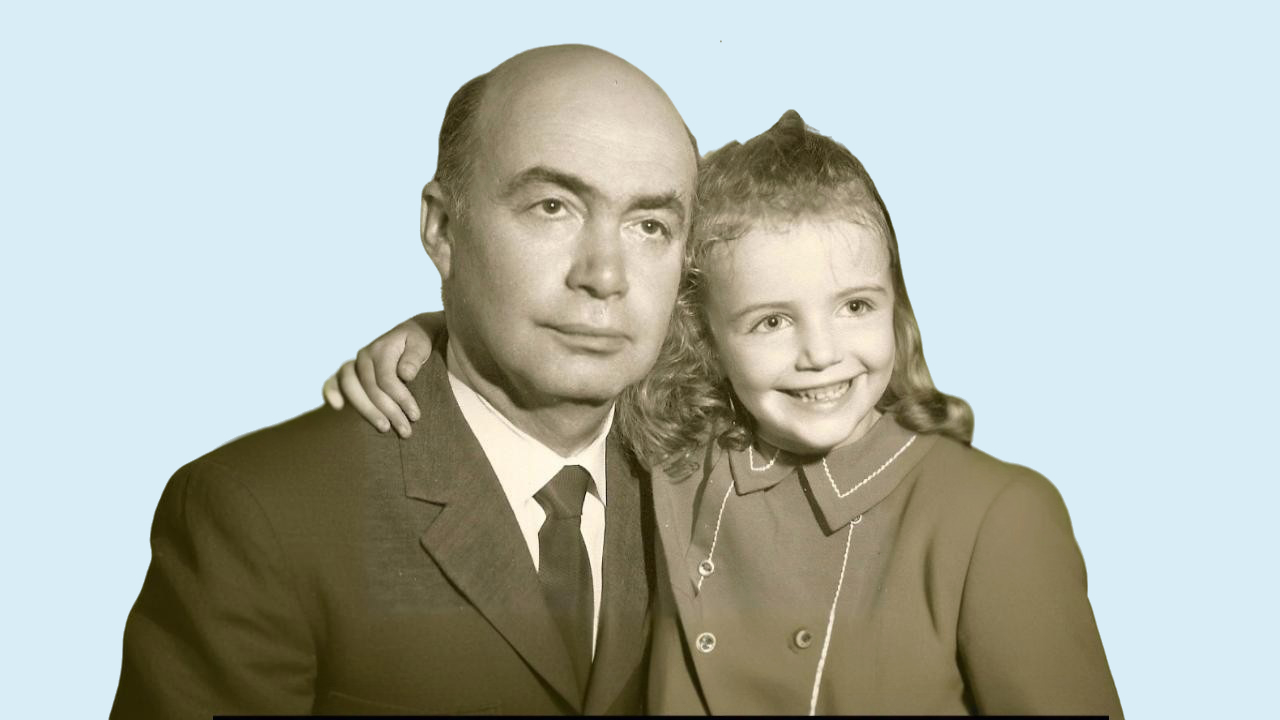
Stories of Hope: My Silver Spoon
A Soviet Jewish childhood shaped by family discipline and hard-earned values became the backbone of an émigré’s resilience and later professional success
Editor’s Note: At a time when headlines are dominated by war, loss, and division, The Media Line has launched a new series, Stories of Hope, to make room for something often missing from the news cycle: stories that illuminate resilience, meaning, and the human capacity to endure and build, even in difficult circumstances. These pieces do not deny hardship or pain. Rather, they explore moments of purpose, courage, creativity, and connection—sometimes quiet, sometimes bold—that remind us what is still possible.
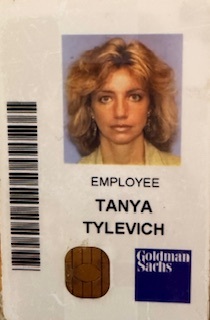
I start work at Goldman Sachs, August 1999. (Courtesy Tanya Tylevich)
What most of them didn’t realize—except for my mom, of course—was that this wasn’t a lucky break. It was something I had worked toward almost from the day I was born. So, let’s use a little agile thinking and “walk backward” to see how it all really began…
I wasn’t born with a silver spoon—mainly because no one in the USSR was. We were all supposed to be equal. I was born in Leningrad (now St. Petersburg), one of the most beautiful cities in the world, with its imperial elegance, masterful urban design, and grand architecture planned from day one to be Russia’s capital—the intellectual heart of the Soviet Union. It had one of the finest school systems—rivaled only by Moscow—along with world-class museums, theaters, and art schools. In the Soviet Union, you couldn’t just choose where to live. Most people dreamed of living in Moscow or Leningrad, but it only happened if you were born there or married in. So yes, I was incredibly lucky.
Then there was another big influence: my family—of course. From an early age, independence and education were non-negotiables (my sister and I were signed up for piano lessons before we could spell “Mozart”). School was serious business, and relying on looks was strictly off-limits. My parents made it clear—brains, not beauty, would take you places.
Long before I was even born, my mom had already decided I’d be a double major in math and literature. My dad imagined me sketching away in art school and spending weekends wandering the Hermitage. And my grandma? She saw it all coming—and made sure I lived by the golden rule: “Treat people the way you want to be treated.” I carry a little piece of each of them with me: leadership and communication from my mom, a love of the arts and deep-rooted pride from my dad, and my grandma’s timeless wisdom—especially her fashion mantra: “We’re not rich enough to buy cheap clothes.”
A fair question is this: If my future was so well mapped out, how did I end up an émigré instead of a well-established Ph.D. or artist in St. Petersburg? The answer is both simple and complicated. In the USSR, it wasn’t me who got to define my future—it was the government. The hard truth was that no matter how many piano recitals you played, how many books you read, or how many times you visited the Hermitage, your last name, background, and beliefs could outweigh your test scores.
Growing up, I lived in a country where double standards were not only common—they were practically encouraged. In the Soviet Union, “nationality” didn’t mean your citizenship, as it does in most places. It meant your ethnic origin—and it was stamped right in your passport. Instead of saying you were Soviet, your passport would list you as Russian, Ukrainian … or Jewish. And being Jewish often meant you were treated differently—from school to job opportunities and beyond. Sometimes this treatment was based on the nationality listed in your USSR passport, other times on your appearance, or even just the spelling of your last name. Most people in the USSR could often tell if someone was Jewish just by how they looked. It may sound unsettling, but it was true.
Give the gift of hope
We practice what we preach:
accurate, fearless journalism. But we can't do it alone.
- On the ground in Gaza, Syria, Israel, Egypt, Pakistan, and more
- Our program trained more than 100 journalists
- Calling out fake news and reporting real facts
- On the ground in Gaza, Syria, Israel, Egypt, Pakistan, and more
- Our program trained more than 100 journalists
- Calling out fake news and reporting real facts
Join us.
Support The Media Line. Save democracy.


In that anti-religious society, most Jewish families—especially in cities like Leningrad and Moscow—didn’t speak Hebrew or Yiddish and didn’t go to temple. And yet, somehow, people always knew. From childhood, we were acutely aware of these double standards. There were two versions of the truth—one for home and one for school. Even a 7-year-old could feel the difference and learn to navigate between them.

In 1st grade, 1974. (Courtesy Tanya Tylevich)
At the age of 12, I had a conversation with my dad that profoundly shaped my future. At the time, I was deeply immersed in drawing and painting—I had spent seven years of my childhood in art school. Yes, I dreamed of becoming an artist. Though I wasn’t even a teenager yet, my dad sat me down and gently explained a painful truth: With my Jewish last name and my face, he said, the chances of being accepted into the St. Petersburg Art Academy were slim.
Even now, I can still hear his voice: “Tanechka, you are talented—you may even be very talented. But you’re not a genius. And they won’t give you a chance.” My papa told me I might be accepted into the architecture program within the Civil Engineering college, but not the Art Academy. “I’m sorry, honey. I know how hard you’ve worked for this dream… But this is the reality. This is your country—but to them, we’re different. You’ll understand when you’re older.” And just like that, I put down my pencils and brushes—and didn’t pick them up again for years…
Fast-forward past my joyful childhood, and we land at Leningrad airport in 1989…
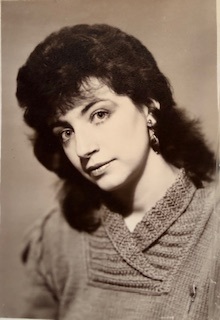
A month or two before leaving the USSR, fall 1989. (Courtesy Tanya Tylevich)
In many ways, my story mirrors that of so many “kids” in their early 20s who crossed the Soviet border. We didn’t want to leave our predicted futures, but we chose to break barriers and chart our own paths. We picked the moon-shot journey: We knew our point of departure, but the destination was a mystery. The code word “to leave” meant to flee—once and for all. Farewell parties felt more like funerals in their finality. Our Soviet “exit visa,” which came without an entry visa to any country, was the only identity document we held in our hands.
Looking back now, I know that the magic of my so-called silver spoon—the one I told you about earlier—absolutely shaped me. But let’s be honest: That silver spoon didn’t show up at Leningrad airport to help carry my bags. On December 22, 1989, I somehow just knew—felt it deep in my bones—that my childhood and youth (yes, even though I was only 22) had ended. From that moment on, it wasn’t family plans or Soviet predictions that would define me—it was just me, my determination, and whatever I could fit into two suitcases.
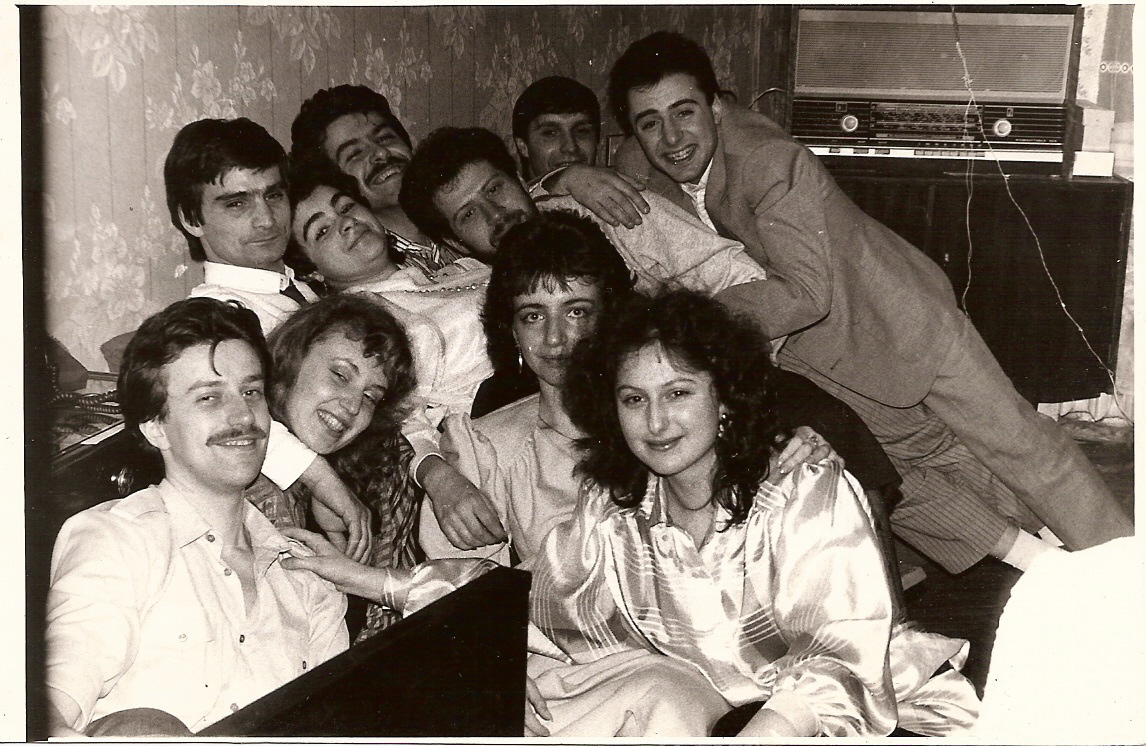
Tanya Tylevich (1st row, 2nd R) and other Russians in their 20s prepare to leave the country, 1989. (Courtesy Tanya Tylevich)
I still remember that strange moment of stillness. I looked through the fence at my friends and family standing on the other side, and it hit me—really hit me—that it would be a very long time before I’d be allowed to cross that border again. That realization, even more than the freezing Leningrad winter, made me shiver. Now that I’m a mom myself, I honestly can’t even imagine what our moms were feeling that day—watching their kids walk toward the unknown, knowing they might never come back. I didn’t fully grasp it then…
To clarify what “the other side of the fence” meant, the Soviet government didn’t exactly send us off with flowers and warm wishes. We weren’t citizens anymore—we were treated as traitors, defectors, stateless people who had to be punished on our way out. In the Soviet Union, everything you had—your apartment, your job, even your college diploma—was technically owned by the state. So, when we left, we were stripped of almost everything: homes, belongings, jewelry, even our own diplomas—all considered state property. What we could take had to fit into two suitcases. Clothes. Copies of diplomas. A few photos. That was it.
After that came the final “inspection.” I was pulled aside by a female customs officer and escorted to a small room, where a doctor asked me to sit in a gynecological chair to check if I was smuggling out diamonds. Not exactly the farewell scene you see in romantic films. Honestly, that little moment of Soviet hospitality was one of the big reasons I never took back Russian citizenship when it was later offered to us before the end of the 20th century … but that’s a whole other story.
Before I turn the page to New York, I have to confess: Leaving Leningrad tore a part of my soul out of me. The city didn’t simply exist around me—it lived in me. Walking through its streets and along its embankments gave me strength; it made me feel complete. Its icy winds toughened my spirit, its quiet canals carried my secrets, and its grandeur whispered that I was part of something bigger, something enduring. No matter where I go, nothing ever feels the same. Saying I loved my home city doesn’t begin to capture it—I carried it in my blood, I breathed it in every day. I was bound to it, heart and soul.
History was never abstract in my family. I was born into a family that survived World War II, in a city that survived the Siege of Leningrad—900 days of unimaginable suffering (September 8, 1941–January 27, 1944). More than a million people died from starvation, freezing temperatures, and relentless shelling. Daily rations were just 250 grams of bread for adults, 125 for children. My mom was one of those children. She watched her father die of hunger. I grew up hearing the Siege stories from my mom and grandma. As Elie Wiesel said, “When you listen to a witness, you become a witness.”
Because my family’s roots were so deeply tied to Leningrad, my decision to leave carried enormous emotional weight. I was the only one from my family who left, and I couldn’t shake the feeling that I was betraying what my grandfather had died for during the Siege—erasing everything they had cried for, hoped for, and dreamed of.
Worse still, the moment I applied for permission to emigrate, my entire family would be branded second-class citizens by the Soviets. That’s not an easy burden to carry at 22.
Returning to my city once more, whenever I feel nostalgic about my childhood or youth, those memories are inseparable from Leningrad. Its resilience, its sorrow, its soul—etched into who I became. All my life, I’ve been so proud to say I was born in Leningrad. It was—and still feels like—a true fortune.
What I’ll never forget is where I came from. My Soviet Jewry refugee story isn’t just part of my past—it’s my foundation, my compass. It reminds me that resilience is in my DNA. That even when you’re torn from the place that shaped you, you carry it forward—in how you live, lead, and love.
