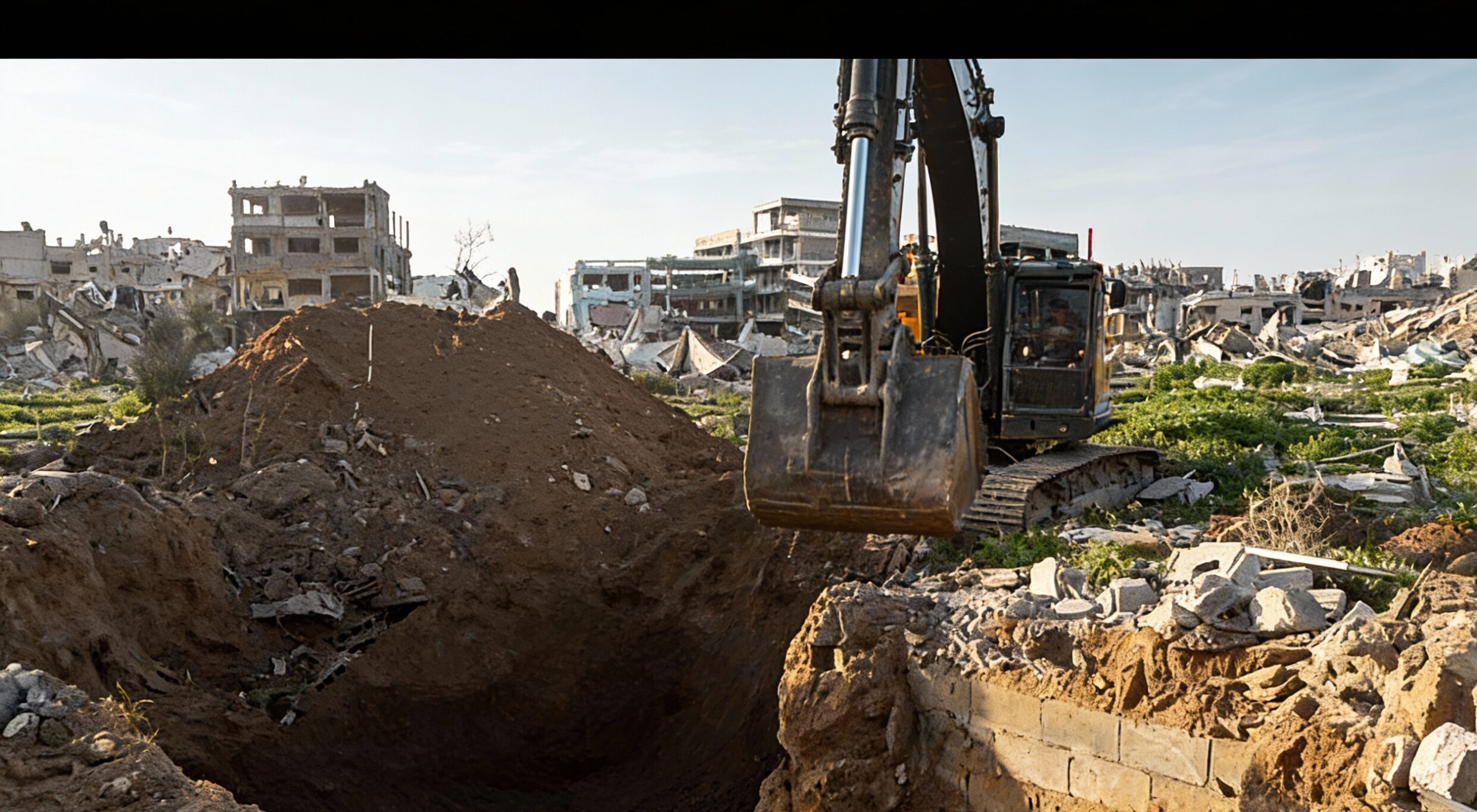
Joyful Homecoming of Final Israeli Hostage Tempered With Bitter Warning About Hamas Deals
As news circulated that the last Israeli hostage had been returned from the Gaza Strip, family members, public figures, and organizations responded with gratitude and relief, calling it the end of a painful chapter in Israel’s history.
Alongside the expressions of closure was a stark warning from the head of a legal advocacy NGO: The difficulty of recovering the final remains of Ran Gvili should serve as a reminder not to trust Hamas to fulfill its agreements.
Gvili was a 24-year-old officer in the Israel Police’s Yasam Special Patrol Unit from Meitar. He was killed fighting terrorists during the Hamas-led Oct. 7, 2023 attack and taken into the Gaza Strip, becoming the last remaining Israeli hostage there.
His parents, Talik and Itzhak Gvili, advocated tirelessly for his return. Along with hostage advocacy groups and protesters, they urged the Israeli government not to continue with the three-phase, 20-point peace plan backed by the US until their son’s remains were brought home.
In a Facebook post shortly after the announcement on Monday, Talik Gvili wrote: “The first to go out, the last to return. Our hero.”
Give the gift of hope
We practice what we preach:
accurate, fearless journalism. But we can't do it alone.
- On the ground in Gaza, Syria, Israel, Egypt, Pakistan, and more
- Our program trained more than 100 journalists
- Calling out fake news and reporting real facts
- On the ground in Gaza, Syria, Israel, Egypt, Pakistan, and more
- Our program trained more than 100 journalists
- Calling out fake news and reporting real facts
Join us.
Support The Media Line. Save democracy.


Israel Defense Forces (IDF) Chief of Staff Lt. Gen. Eyal Zamir spoke with the hostage’s parents by telephone. “We upheld our commitment that no one would be left behind,” Zamir told them. “IDF troops, the combat forces on the front lines and the entire nation are profoundly moved by Ran’s return for a Jewish burial. The news is painful, yet it also brings significant relief. I’m grateful we were able to close this circle, and I extend my condolences and a very warm embrace.”
“The last hostage in Gaza has been brought home. First to enter. Last to return,” the Hostages and Families Forum said in a statement. “Ran, with his broad shoulders and radiant smile, was all heart. A true friend, loved by everyone,” it read.
Israeli President Isaac Herzog said in a statement, “An entire nation prayed and waited for this moment, and now the circle is closed. May his memory be a blessing.”
Opposition Leader Yair Lapid said, “I welcome the conclusion of the identification process of the final abducted soldier, Israeli hero Ran Gvili of blessed memory, who will at last receive a proper burial in Israel. Ran, a Yasam fighter who battled on October 7, was the last hostage in Gaza. I embrace his family, recognize how hard you worked for his return, and commend the security forces who did everything to bring him home.”
Even as many expressed relief, several voices warned about the peril Israel faces in relying on Hamas to fulfill agreements—first to return all hostages, and in the next stage, to fully disarm.
Nitsana Darshan-Leitner, president and founder of the legal advocacy NGO Shurat HaDin—Israel Law Center, said, “Ran Gvili is a symptom of the entire Trump plan for Gaza and the proposed Board of Peace. Just as Hamas acted in bad faith during the agreement—knowing where the last hostage was held and refusing to cooperate with Israel to secure his return—Israel was ultimately forced to enter and do the job itself.”
She added, “The same pattern will repeat: Hamas will refuse to disarm and surrender, and once again, Israel will be left with no choice but to go in and complete the mission on its own. In the end, Israel will once again be expected to pay the price for illusions others are free to entertain.”
The US-brokered ceasefire between Israel and Hamas took effect on October 10, 2025, after Israel’s cabinet approved the agreement. The timeline required Hamas to return all hostages—both living and deceased—within about 72 hours. The return of bodies was a stated condition before the deal could advance to its second phase, which included steps such as reopening the Rafah crossing and broader reconstruction measures.
Sgt. Gvili’s remains, however, were not returned until January 26, 2026—roughly three and a half months after the agreement took effect. Israeli officials said throughout that they knew Hamas was holding his body and insisted the plan could not move forward without the return of his remains. Hamas maintained it had shared all available information. The timing of the return, just days before the planned transition to phase two, was viewed by many in Israel as a deliberate delay and leverage held until the final moment, reinforcing a widely held belief that the group engages in deceptive tactics.
