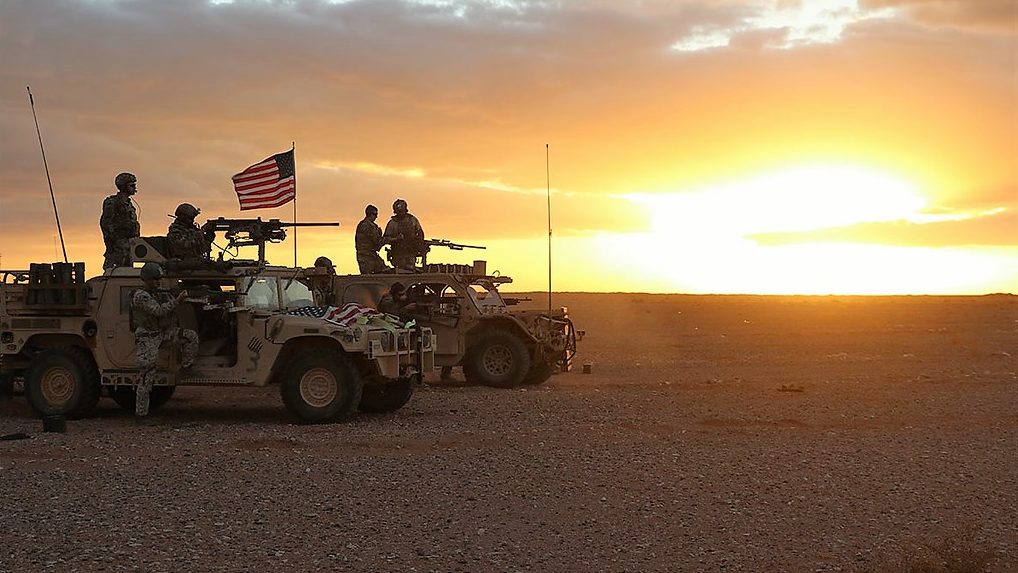
Syrian Army Takes Control of Al-Tanf Base After US Withdrawal
[DAMASCUS] The Syrian Ministry of Defense announced Thursday that the Syrian Arab Army has taken control of the Al-Tanf military base located in the Syrian desert near the border triangle with Iraq and Jordan, following the complete withdrawal of US forces from the site, according to an official statement issued by the ministry.
A Syrian military source told The Media Line that units of the Syrian army, “through coordination with the American side,” took over the base, secured it and its surroundings, and began deploying along the Syrian-Iraqi-Jordanian border to ensure control of the area.
The source, who requested anonymity, confirmed that Border Guard forces will, in the coming days, initiate a series of measures to consolidate their deployment around the base and in the surrounding desert area.
The Al-Tanf base is located in the border triangle between Syria, Jordan and Iraq. It was established in 2014 to serve as a primary center for the operations of the US-led international coalition against the Islamic State (ISIS) in the Syrian desert.
Give the gift of hope
We practice what we preach:
accurate, fearless journalism. But we can't do it alone.
- On the ground in Gaza, Syria, Israel, Egypt, Pakistan, and more
- Our program trained more than 100 journalists
- Calling out fake news and reporting real facts
- On the ground in Gaza, Syria, Israel, Egypt, Pakistan, and more
- Our program trained more than 100 journalists
- Calling out fake news and reporting real facts
Join us.
Support The Media Line. Save democracy.
Although its presence was relatively limited compared with US forces in northeastern Syria, the base played a broad strategic role that extended beyond military confrontation with the extremist group to include shaping regional balances and countering Iranian influence through Tehran-backed militias.
Al-Tanf was designed to prevent the establishment a land corridor connecting Iraq to Syria and Lebanon, one of Tehran’s goals that has raised concerns among Washington’s partners and Western and regional countries. Additionally, the US presence at Al-Tanf protected civilians and displaced people in the Rukban camp, although their numbers have declined over the years due to agreements with Damascus and other population movements.
The United States’ evacuation from Al-Tanf to Jordan on Wednesday has raised questions about the future of the American presence in Syria and the security balances in the region. The Syrian Observatory for Human Rights monitored the withdrawal of forces via coalition convoys heading toward Jordanian territory, ending years of deployment at one of the country’s most sensitive military sites.
This step reflects a broader review of the US military presence in Syria, which began more than a decade ago during the war against ISIS but has seen successive reductions in troop numbers and deployment points. Pentagon reports last year indicated a strategy to reduce forces to fewer than 1,000 troops while reassessing the need for multiple bases, focusing influence on locations that are less costly and possibly more operationally significant.
The recent withdrawal from Al-Tanf comes amid broader geopolitical shifts in Syria and the region, where recent years have seen agreements and understandings between Damascus and local forces such as the Syrian Democratic Forces (SDF) with mutual concessions of territorial control and political recognition, including Damascus’ step to officially join the international coalition against ISIS.
The relocation of US forces to Jordan reflects changes in American priorities after years of fighting against the ISIS, including a gradual withdrawal and reducing political and military costs of an open presence in a country still in a post-conflict stage. Additionally, shifting regional balances, particularly with the emerging roles of regional players such as Russia, Iran and Turkey, are reshaping expectations regarding the scope of foreign interventions in Syria.
The withdrawal from Al-Tanf does not mean the end of the American presence in Syria, but it indicates a new transitional phase that requires reorganizing the military and diplomatic presence, balancing deterrence capabilities against remaining threats and managing relations with new political forces in Syria and the region.
This shift raises questions about who will fill the vacuum in the areas left by US forces and how regional and international actors will deal with this new reality at a time when security and counterterrorism remain among the most significant challenges affecting the stability of the country and the region.
